Best CMS Platforms for Multilingual Websites: 2025
Creating a multilingual website in 2025 requires a CMS that supports seamless translation, strong SEO for global reach, and scalability to grow with your business. Whether you’re a small business or a large enterprise, the right platform can simplify managing content in multiple languages. Here’s a quick overview of the top CMS options:
- Heylingo: Simplifies multilingual sites with built-in translation for 30+ languages. Affordable plans start at $11/month, scaling with content size.
- WordPress (with plugins): Flexible and popular, but requires plugins like WPML or Polylang for translations. Costs vary based on hosting and plugin subscriptions.
- Drupal: Advanced multilingual tools built into the core, ideal for large-scale projects but requires technical expertise.
- Joomla: Includes multilingual support out of the box, balancing ease of use and scalability for medium-sized sites.
- Headless CMS: Offers unmatched flexibility for delivering multilingual content across platforms but often requires custom development.
- Purpose-Built Platforms: Designed specifically for multilingual needs, offering automated translation and SEO optimization with simple implementation.
Quick Comparison
| Platform | Translation Features | Scalability | SEO Strengths | Cost Range |
|---|---|---|---|---|
| Heylingo | Built-in, 30+ languages | Cloud-based, CDN-supported | Automatic hreflang, sitemaps | $11–$76/month |
| WordPress (Plugins) | Plugin-dependent | Hosting-dependent | Strong with proper plugins | $2.99–$500/month |
| Drupal | Core multilingual modules | Enterprise-ready | Advanced built-in SEO | Free + dev/hosting costs |
| Joomla | Built-in multilingual tools | Medium to large sites | Solid with configuration | Free + hosting/extensions |
| Headless CMS | API-driven, flexible | Exceptional | Developer-dependent | Varies widely |
| Purpose-Built Platforms | Automated, user-friendly | Easily scales | Automatic SEO optimization | Subscription-based |
Choose based on your business size, technical resources, and growth goals. For simplicity, Heylingo or purpose-built platforms are great for small to medium businesses. Drupal and headless CMS work best for enterprises needing advanced customization.
9 Best and Most Popular CMS Platforms in 2025 (Compared)
1. Heylingo
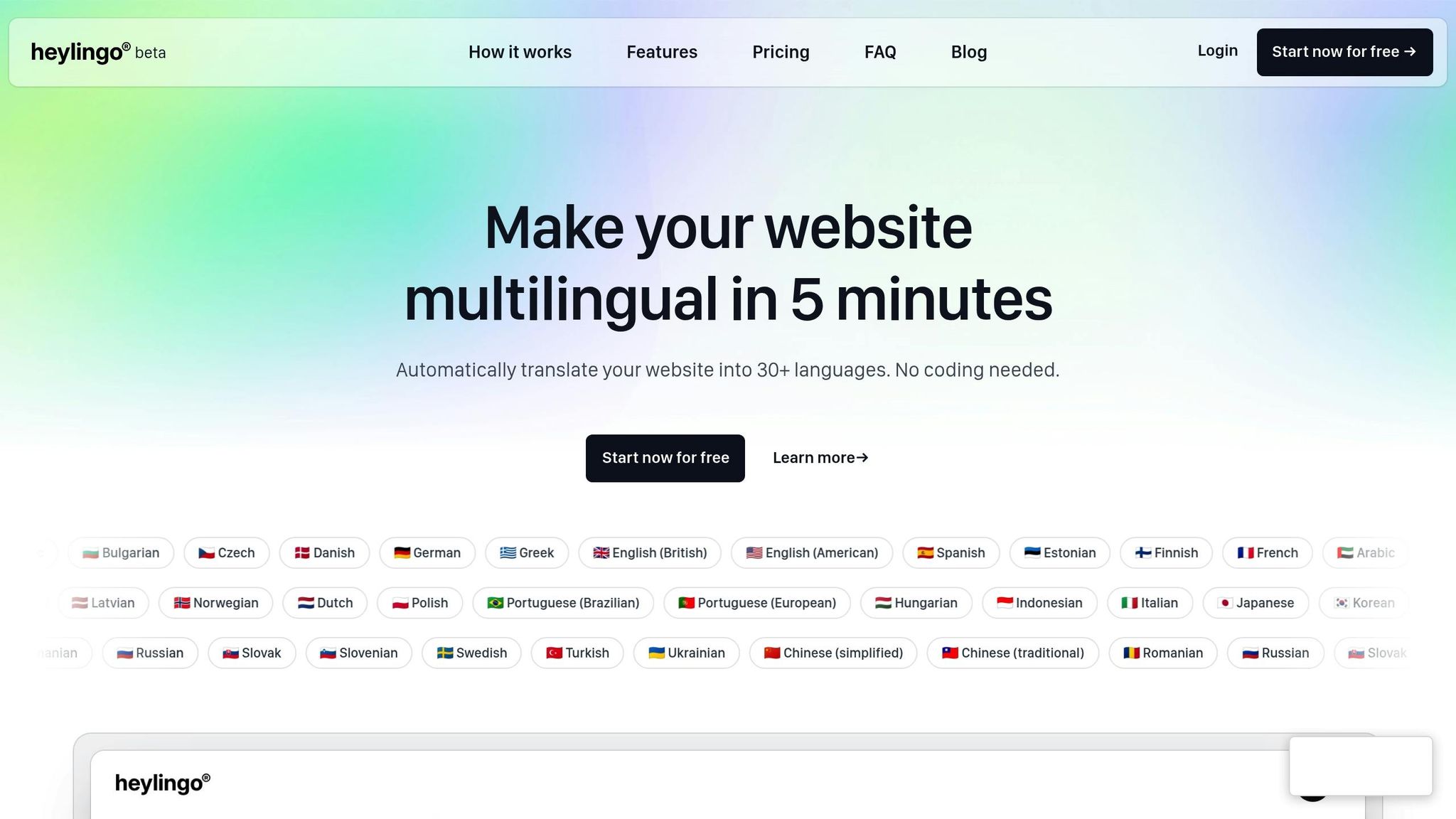
Heylingo is a SaaS platform designed to make website translation effortless. It allows you to convert your site into 30+ languages without needing to write a single line of code. Whether you're managing a WordPress blog, a custom-built application, or an e-commerce store like Shopify, Heylingo integrates seamlessly with any CMS or platform. This flexibility lays the groundwork for its powerful translation capabilities.
Multilingual Capabilities
At the heart of Heylingo is its real-time translation system. By adding a lightweight script to your site, you can activate automatic translations in over 30 languages, helping you connect with audiences across the globe. The platform also includes tools for manual editing and dynamic content updates, so you can fine-tune translations to match your brand’s tone and maintain cultural relevance. Plus, with support for unlimited team members, your content, translation, and marketing teams can easily collaborate to ensure consistency.
Scalability
Heylingo’s pricing model is based on the number of translated characters, making it easy to predict costs as your site grows. Plans range from 100,000 characters (about 20,000 words) for $11/month to 1,000,000 characters (around 200,000 words) for $76/month. This setup works well for businesses of all sizes. For instance, a small blog publishing 10–15 articles a month might find the Starter or Pro plan sufficient, while a large e-commerce site with hundreds of product descriptions could benefit from the Business or Scale plans. To ensure fast load times for your multilingual pages, the platform uses a global CDN, so your content is delivered quickly no matter where your visitors are.
Cost and Pricing Models
Heylingo offers four pricing tiers, all tailored to different content needs:
| Plan | Monthly Cost | Character Limit | Approximate Word Count | Best For |
|---|---|---|---|---|
| Starter | $11 | 100,000 | ~20,000 words | Small websites, blogs, landing pages |
| Pro | $32 | 300,000 | ~60,000 words | Growing businesses, medium-sized blogs |
| Business | $54 | 600,000 | ~100,000 words | E-commerce stores, content-heavy sites |
| Scale | $76 | 1,000,000 | ~200,000 words | Large websites, enterprise content |
All plans include access to 30+ languages, unlimited team members, and the full suite of features. Heylingo is also GDPR compliant, ensuring your data is handled securely and meets privacy regulations. For businesses testing the waters in international markets, the Starter plan provides an affordable entry point. As your needs expand, the higher-tier plans offer the capacity to scale efficiently, helping you meet the demands of a growing global audience.
2. WordPress with Translation Plugins
WordPress isn't a dedicated translation platform, but it supports multilingual functionality through a variety of translation plugins, making it a flexible option for users.
With over 43% of websites worldwide running on WordPress, it's a popular choice for building multilingual sites. While WordPress itself is free and open-source, you’ll need translation plugins to add multilingual features, giving you the freedom to select the plugin that matches your budget and requirements.
Multilingual Capabilities
WordPress relies on PO/MO files for translations, which can be manually edited using tools like Poedit. However, most users opt for translation plugins because they simplify the process. Plugins like WPML, Polylang, and TranslatePress allow you to translate everything from posts and pages to tags, categories, and even themes - no coding required.
These plugins often feature a visual editor where you can see real-time changes, making it easier to preview how your content will look in different languages. If you're running an online store, TranslatePress integrates seamlessly with WooCommerce, enabling translations for product pages, shopping carts, and checkout flows.
For businesses needing professional-grade translations, tools like WPML support XLIFF file import and export, streamlining collaboration with translation agencies by eliminating manual copy-pasting. Many plugins also offer integration with professional translation services.
For advanced setups, plugins like WPML and Polylang support headless WordPress by delivering multilingual content through REST API or GraphQL endpoints. This flexibility ensures WordPress can handle growing content demands.
Scalability
The scalability of WordPress largely depends on your hosting solution and plugin configuration. With access to over 59,000 plugins, you can extend your site’s functionality as it grows. For small to medium-sized businesses, shared hosting combined with a translation plugin is often sufficient. However, as traffic increases, upgrading to managed WordPress hosting or a virtual private server becomes essential to maintain performance.
At the enterprise level, managing a large multilingual site requires careful planning. WordPress relies on plugins and custom code to handle large-scale governance and multisite consistency. While managing dozens of languages or hundreds of thousands of pages can be complex, the right hosting infrastructure and plugin setup make it possible to support even the most demanding multilingual operations.
SEO Optimization
WordPress is built with search engine optimization in mind, making it easy to create SEO-friendly URLs, categories, and tags. Adding translation plugins further enhances SEO for multilingual sites. These plugins handle technical requirements like hreflang tags, which guide search engines on which language version to display, and generate multilingual sitemaps. Additionally, WordPress’s vast plugin ecosystem allows you to integrate SEO, analytics, and marketing tools to boost your site’s visibility and performance.
Cost and Pricing Models
WordPress itself is free, but you’ll need to budget for hosting and domains. Hosting typically costs around $7.99/month (or as low as $2.99/month during promotions), while domain registration ranges from $9 to $15 per year. Translation plugins are usually subscription-based, with small businesses spending approximately $15–$30/month, and larger organizations paying between $200 and $500/month. Premium themes and additional plugins for features like e-commerce, forms, or advanced SEO can also add to your expenses.
This flexible pricing structure allows businesses to start small and scale their multilingual capabilities over time.
3. Drupal
Drupal is a robust open-source CMS that excels at managing multilingual websites. Unlike WordPress, which relies on plugins for translation functionality, Drupal includes multilingual capabilities directly in its core. While the platform is free to download, it requires technical expertise and ongoing investment in development and maintenance. Let’s dive into how Drupal’s multilingual tools and features make it a strong choice for complex language management.
Multilingual Capabilities
Drupal’s multilingual functionality is built directly into its core, eliminating the need for third-party plugins. It offers four key modules that work seamlessly together: Language, Content Translation, Configuration Translation, and Interface Translation. These modules enable you to translate everything from website content and menus to system messages and administrative interfaces.
The platform also simplifies language detection. It can automatically identify a user’s preferred language through methods such as URL prefixes (e.g., example.com/es/ for Spanish), domain names, browser settings, or user preferences. This flexibility allows you to structure your multilingual site in a way that supports both SEO goals and user experience.
Editors can work with side-by-side translations using built-in workflows that ensure content is routed for approval, maintaining quality and consistency across all languages. Additionally, Drupal supports XLIFF file formats for seamless export and import of translations, and it integrates with translation management systems to meet modern localization needs.
Scalability
Drupal is designed to handle massive, content-heavy multilingual websites, making it a go-to choice for government agencies, universities, and large enterprises. Its architecture is built to support high-traffic sites while maintaining top-notch performance and security.
However, this scalability comes at a cost. Managing enterprise-scale multilingual deployments with Drupal requires significant investment in DevOps, performance tuning, and security updates. To ensure reliable performance during peak traffic periods, organizations must dedicate resources to performance engineering and ongoing system maintenance.
Thanks to its modular architecture, Drupal allows you to add new features as your needs evolve. However, this flexibility means that scaling efficiently across multiple languages and regions will depend on how well your solutions are architected. Unlike simpler CMS platforms, Drupal requires a more hands-on approach to manage its extensive capabilities.
SEO Optimization
Drupal addresses multilingual SEO needs with both core features and contributed modules. It automatically generates hreflang tags and language-specific sitemaps, which are essential for optimizing search visibility across different languages. Additionally, it supports customizable URL structures for each language, giving you control over how your site appears in search results.
The platform also provides detailed control over metadata, allowing you to tailor titles, descriptions, and structured data for each language version. This level of customization is particularly useful for organizations targeting different keywords and strategies in various markets.
With clean code and semantic HTML output, Drupal creates a strong technical foundation for SEO. It also integrates with analytics tools, enabling you to monitor the performance of your multilingual content and refine your strategy based on data insights.
Cost and Pricing Models
While Drupal itself is free, building and maintaining a multilingual site with it involves significant costs. You’ll need to budget for robust hosting, SSL certification, and domain registration. On top of that, custom development and ongoing maintenance - like performance tuning and security updates - require a team of skilled developers.
Drupal’s steep learning curve means that experienced developers are essential, both during the initial setup and for ongoing maintenance. For enterprise-scale multilingual websites, you’ll need a dedicated team to handle everything from security updates to performance optimization and custom feature development.
When planning your budget, consider the entire lifecycle of your site. This includes initial development, regular maintenance, security patches, and periodic upgrades. Organizations that choose Drupal often do so because they require its advanced features and are prepared to invest in the technical expertise needed to fully utilize its potential.
4. Joomla
Joomla is a powerhouse in the CMS world, supporting nearly 2 million active websites globally. It accounts for over 9% of all known business websites and holds more than 6% of the global CMS market share. What sets Joomla apart is its built-in multilingual capabilities, which remove the need for third-party translation plugins. While it has a steeper learning curve than WordPress, it’s more accessible than Drupal, striking a balance that appeals to many users.
Multilingual Capabilities
One of Joomla’s standout features is its seamless multilingual support. With over 70 translation packs available right out of the box, it simplifies the process of creating multilingual websites by covering both interface elements and admin panels.
"With over 70 translation packs available for the core and out-of-the-box multilingual content management and language associations, creating multilingual websites with Joomla is simple."
– Joomla.org
Joomla 4.3.4 takes this a step further by offering a one-click setup for essential multilingual components. This includes menus, categories, articles, and plugins like System - Language Code, System - Language Filter, and Web Services - Languages. The platform’s content association tool links translated versions of content across different languages, which not only enhances the user experience but also boosts SEO. Additionally, the built-in language switcher allows visitors to select their preferred language or rely on auto-detection settings. For even greater control, Joomla’s override system lets you translate any string in the system, including those from third-party extensions.
Scalability
Joomla is designed to handle medium to large websites and complex online applications, making it a dependable choice for businesses with multilingual needs. Its flexibility ensures that even as your website grows, you won’t need to switch platforms.
SEO Optimization
Joomla’s multilingual architecture is a strong ally for SEO. The content association system links translated pages, helping search engines understand the connections between different language versions. This improves crawling and indexing. Combined with clean code and customizable URL structures, Joomla provides a solid foundation for search optimization. Plus, offering content in multiple languages increases engagement by catering to users’ language preferences.
Cost and Pricing Models
Joomla’s core software is completely free under the GPL license. The main costs associated with Joomla are hosting and development. Hosting expenses vary depending on your site’s size and traffic - smaller sites can opt for budget-friendly options, while more robust plans are ideal for high-traffic, multilingual sites. Given Joomla’s steeper learning curve, you may need to allocate funds for developer expertise or team training. However, its built-in multilingual tools eliminate the need for separate translation plugins, which can save money. You might still consider investing in extensions to enhance specific functionalities. Overall, Joomla’s cost typically lands between WordPress and Drupal, offering a strong value for organizations seeking comprehensive multilingual features without the complexity of enterprise-level platforms.
sbb-itb-8482ffa
5. Headless and API-First CMS Solutions
Headless and API-first CMS platforms represent a modern approach to content management. They separate the backend content repository from the frontend presentation layer, allowing content to be distributed across websites, mobile apps, IoT devices, and digital displays via APIs. For multilingual websites, this means translations can be managed centrally and deployed wherever your audience is. While traditional CMS platforms also prioritize scalability and SEO, headless solutions offer unmatched flexibility for delivering content across multiple channels.
Unlike traditional systems where content and presentation are tightly connected, headless CMS platforms focus solely on storing, organizing, and delivering content. The frontend is handled independently, enabling fast, dynamic experiences powered by frameworks like React, Vue.js, or Next.js. This separation is especially useful for global brands that must maintain consistent multilingual content across numerous digital platforms.
Multilingual Capabilities
Headless CMS platforms handle multilingual content through structured content models. These models treat language as a field or dimension, enabling you to create content once and add translations as separate entries or variants linked to the original. They also support language fallbacks, so if a user’s preferred language isn’t available, the system automatically displays content in a default language. APIs can integrate with external translation tools and AI services, automating the translation and publishing process, which removes much of the manual workload.
Localization goes beyond simple text translation. These platforms allow you to manage region-specific images, videos, currency formats, date formats, and even content structures tailored to specific markets. For example, a U.S. product page might highlight different details than its counterpart in another region, all within the same content model using locale-specific variations.
This flexibility also extends to URL structures and routing. Developers can implement strategies such as subdomains (e.g., fr.example.com), subdirectories (e.g., /fr/), or separate domains for different languages. The headless CMS delivers the right content via API calls based on the requested locale. Unlike more integrated systems, headless platforms allow content and presentation to scale independently, making them ideal for multilingual projects with complex needs.
Scalability
Headless CMS platforms are built to handle global audiences, thanks to their cloud-based infrastructure. With a decoupled architecture, the content API can scale independently from frontend applications, allowing you to optimize each layer based on demand.
Content delivery networks (CDNs) integrate seamlessly with headless systems. This means your content is cached at edge locations worldwide, ensuring fast load times no matter where users are. For instance, when a user in Tokyo requests Spanish-language content, it’s served from a nearby server rather than traveling from your origin server. This global distribution is critical for maintaining performance across multilingual sites.
The API-first design also supports scalability across multiple channels. As your business expands into new markets or platforms, you don’t need to overhaul your content infrastructure. The same multilingual repository can power websites, mobile apps, voice assistants, and future technologies. This reduces technical complexity and allows your team to focus on creating quality translations rather than juggling multiple systems.
SEO Optimization
A headless CMS provides the tools for robust SEO, but proper implementation is key. Tasks like configuring hreflang tags, canonical URLs, and language-specific sitemaps fall to your development team. The advantage? Complete control over how pages are rendered.
With headless systems, you can choose server-side rendering (SSR) or static site generation (SSG) to ensure search engines can crawl and index your multilingual content. These methods generate fully rendered HTML pages, making them easier for search bots to process.
Structured content models also help maintain SEO consistency. By defining required fields for meta titles, descriptions, and structured data at the content model level, you ensure every translated page includes essential SEO elements. This minimizes the risk of missing metadata that could hurt your search rankings.
Performance plays a huge role in SEO, and headless architectures typically deliver faster load times. Modern frontend frameworks, optimized asset delivery, and efficient caching strategies contribute to better performance. Google’s Core Web Vitals metrics reward fast, responsive sites, giving well-optimized headless multilingual sites a competitive edge.
Cost and Pricing Models
Headless CMS platforms generally use subscription-based pricing, which varies depending on factors like the number of API calls, content entries, users, and supported locales. Entry-level plans cater to smaller projects, while enterprise solutions scale with usage, support requirements, and advanced features.
However, the total cost of ownership goes beyond the CMS subscription. Frontend development and maintenance require skilled developers experienced with modern JavaScript frameworks and API integration. Additionally, hosting costs for the frontend application - using providers like Vercel, Netlify, or AWS Amplify - should be considered. These services often charge based on bandwidth, build minutes, and serverless function executions.
Integrating translation management tools may require third-party services or custom development to automate workflows. Fortunately, the API-first design allows you to integrate best-in-class translation tools without overhauling your content system. This flexibility can help avoid vendor lock-in and reduce costs in the long run.
For organizations with experienced development teams, headless CMS platforms provide a solid foundation to manage and scale multilingual content. While the upfront investment may seem high, the benefits - better performance, scalability, and streamlined workflows - make it a worthwhile choice for businesses with complex content needs.
6. Purpose-Built Multilingual Platforms
Purpose-built multilingual platforms take the idea of content management a step further by offering a streamlined, all-in-one solution for handling multiple languages. Unlike general CMS platforms that often need plugins or extensive configuration, these platforms are designed with translation and localization features baked right into their core. The result? A simplified workflow that makes launching multilingual content faster and less complex.
These platforms are user-friendly, enabling non-technical users to manage translations without needing to dive into code or tweak complicated settings. By automating essential tasks - like translation, URL structuring, and SEO optimization - they save time and resources, making it easier for businesses to expand their global presence without needing large technical teams.
Multilingual Capabilities
These platforms treat multilingual functionality as a core feature, not an afterthought. Translation workflows are seamlessly integrated into the content management interface, often displaying translations side-by-side with the original content for easy editing.
Many of these platforms also include machine translation tools, offering instant translations that can later be fine-tuned for accuracy and regional nuances. Real-time updates ensure that any changes to the original content are quickly reflected in all language versions.
To enhance the user experience, features like automatic language detection serve visitors the appropriate version of the site based on their browser settings or location. Manual language switchers are also available, giving users the option to choose their preferred language.
Other helpful tools include visual indicators that show translation progress, making it easy for teams to track which pages need updates. Some platforms even include translation memory, which stores previously translated phrases to ensure consistent terminology across all content.
Localization goes beyond just translating text. These platforms automatically adjust region-specific details like dates, times, currencies, and numbers, reducing the need for manual formatting.
Scalability
As your content and language needs grow, purpose-built multilingual platforms are designed to scale effortlessly. Cloud-based infrastructure ensures consistent performance, with automatic resource allocation to handle increasing demands.
Adding a new language is straightforward, often requiring just a few configuration changes to integrate it into the existing translation workflow. Content delivery networks (CDNs) cache translated content at edge locations, ensuring fast load times for users no matter where they are.
These platforms also support team collaboration with features like role-based permissions and simultaneous editing. This makes it easier for larger organizations to manage multilingual content efficiently. Plus, the lightweight integration - often involving just a small script - keeps your website running smoothly without adding unnecessary technical complexity.
SEO Optimization
Optimizing multilingual websites for search engines can be tricky, but these platforms handle it automatically. They generate hreflang tags to prevent duplicate content issues and ensure that search engines display the correct language version of your site.
URL structures are optimized for SEO, with options for subdirectories (e.g., example.com/es/) or subdomains (e.g., es.example.com). Language-specific sitemaps are created and updated automatically, helping search engines index translated pages more effectively.
Customizable meta tags, titles, and descriptions for each language version further boost search performance and click-through rates. And with efficient content delivery and caching strategies, these platforms help maintain fast page load speeds - an important factor for both user experience and search rankings.
Cost and Pricing Models
Most purpose-built multilingual platforms operate on a subscription model, with pricing that scales based on the amount of translated content and the number of supported languages. Tiered plans cater to businesses of all sizes, from small startups to large enterprises.
Features like unlimited team members, strong security measures, and GDPR compliance are often included across all pricing tiers, providing transparency and predictability in costs. This allows businesses to choose a plan that matches their content needs and growth goals.
Compared to building custom multilingual solutions or juggling multiple translation plugins, these platforms offer a more cost-effective option. Their quick implementation - often requiring just a simple script - makes it easy to launch multilingual capabilities without incurring hefty development expenses.
With their scalability, ease of use, and efficient pricing, purpose-built multilingual platforms are an excellent choice for businesses aiming to expand their global reach.
Pros and Cons
Here’s a breakdown of the strengths and challenges of each CMS option to help you decide which one fits your multilingual website needs. Selecting the right CMS involves weighing features, usability, and costs. Each platform offers distinct advantages and limitations, making it essential to align your choice with your business objectives and technical resources.
The platforms compared here cater to diverse requirements. Some come equipped with built-in multilingual tools, while others rely on plugins or custom development for similar functionality. Factors like scalability, SEO performance, and pricing structures also differ significantly, impacting both initial and long-term costs.
| Platform | Multilingual Features | Scalability | SEO Performance | Pricing |
|---|---|---|---|---|
| Heylingo | Built-in translation for 30+ languages, real-time updates, manual editing, automatic language detection, translation memory | Cloud-based infrastructure with automatic resource allocation, global CDN, and unlimited team member support | Automatic hreflang tags, optimized URL structures, language-specific sitemaps, and fast page load speeds | Transparent subscription model: $11–$77/month based on translated characters (≈20,000–200,000 words), with all features included |
| WordPress with Translation Plugins | Requires third-party plugins for multilingual functionality; premium add-ons enable side-by-side translation editing and machine translation options | Highly scalable with proper hosting and caching, though performance depends on plugin setup | Strong SEO capabilities when configured correctly, though manual hreflang setup is often required | Free core software, with additional costs for a domain ($9–$15/year), hosting ($2.99–$7.99/month), and premium plugins or themes |
| Drupal | Includes multilingual core modules and supports complex translation workflows | Excellent scalability for enterprise needs, though it requires dedicated DevOps resources for performance and security | Robust built-in SEO features with detailed control over URL structures and metadata | Free to download, but significant costs for developer expertise, hosting, and maintenance |
| Joomla | Comes with built-in multilingual support, including an integrated language manager and content association tools | Suitable for medium-sized sites, though optimization may be needed for high-traffic scenarios | Solid SEO capabilities through native features and extensions, but proper configuration is essential | Free to download, with added expenses for hosting, premium extensions, and developer resources |
| Headless and API-First CMS | Provides flexible multilingual content modeling but often requires custom translation workflows integrated with external services | Exceptional scalability via API-first architecture, decoupling frontend and backend performance | SEO performance depends on frontend development, requiring thoughtful technical planning | Pricing varies widely, with potential hidden costs for integrating DAM, visual editing tools, and related solutions |
| Purpose-Built Multilingual Platforms | Bundles translation workflows with machine translation and manual refinement; automates localization of dates, currencies, and numbers | Scales easily with cloud infrastructure, supports new languages seamlessly, and uses CDN-powered content delivery | Delivers automatic SEO optimization, including hreflang tags, sitemaps, and optimized URL structures | Subscription-based pricing scaled by content volume and languages, offering predictable costs without hidden fees |
Key Takeaways
- WordPress is highly flexible, supported by a vast ecosystem of plugins and themes. However, costs can be unpredictable due to hosting fees, premium plugin subscriptions, and performance tuning. Over-reliance on plugins may also complicate updates and audits, requiring careful management.
- Drupal offers strong multilingual capabilities out of the box, making it ideal for enterprise-level projects. That said, its open-source nature demands ongoing technical investment, which may not suit smaller teams or budgets.
- Headless and API-First CMS solutions provide unmatched flexibility by separating content management from presentation. However, integrating additional tools can lead to hidden expenses and increased complexity over time.
- Purpose-built multilingual platforms streamline translation, localization, and SEO in a single package. Their subscription models are straightforward, avoiding surprise costs, and implementation is often simple - sometimes requiring just a lightweight script. This minimizes development needs and speeds up deployment.
For businesses with robust technical teams and a need for deep customization, Drupal or a headless CMS might be the ideal choice. If flexibility and ease of use are your priorities, WordPress with the right plugins can be a solid solution. On the other hand, if your goal is to quickly launch and maintain multilingual content without diving into technical complexities, purpose-built platforms provide the most efficient path forward. Consider your team’s expertise, budget, and long-term growth carefully, as what seems cost-effective initially might demand significant ongoing investment in development and maintenance.
Conclusion
Selecting the right CMS for your multilingual website in 2025 comes down to understanding your business size, technical resources, and growth goals. Defining your priorities upfront will help guide your decision.
For small businesses and startups, simplicity and efficiency are key. Platforms designed specifically for multilingual functionality can get you up and running quickly. These solutions often involve minimal setup - like adding a lightweight script - and handle translation and localization automatically. They also offer predictable subscription costs, making budgeting straightforward. While WordPress with translation plugins is an option, it can lead to ongoing maintenance challenges and unexpected costs over time.
Medium-sized businesses need solutions that offer both flexibility and scalability. Options like WordPress with plugins or Joomla with built-in multilingual support can work well. However, as content grows, managing multiple plugins can become tedious. In such cases, purpose-built platforms can provide a smoother path for future expansion.
For enterprise-level and large e-commerce sites, scalability and customization are critical. Drupal’s multilingual modules are powerful but come with higher technical demands. Headless CMS platforms, on the other hand, offer unmatched flexibility for organizations with dedicated development teams.
E-commerce businesses face unique challenges with translating extensive product catalogs and managing customer interactions. Purpose-built platforms simplify these processes, while WordPress with WooCommerce can serve smaller stores but may struggle to handle larger-scale operations.
Ultimately, the best CMS in 2025 will depend on your specific needs. If speed, ease of use, and predictable costs are your top priorities, purpose-built multilingual platforms are a solid choice. For those with strong technical teams, Drupal or headless CMS solutions provide advanced capabilities. WordPress remains a practical option for businesses already invested in its ecosystem.
As you plan for growth, remember that what seems cost-effective today might require significant maintenance or upgrades down the line. Choose a CMS that not only meets your current needs but also supports your long-term goals. Use these insights to find the platform that best aligns with your global ambitions.
FAQs
What should I look for in a CMS to build a multilingual website in 2025?
When picking a CMS for a multilingual website in 2025, focus on tools that make it easier to manage content across different languages and regions. Multilingual support is crucial - opt for a platform that handles translations and language-specific content without hassle.
Check for localization features that adjust content to match regional preferences. This includes things like date formats (MM/DD/YYYY), currency symbols (like $), and regional details that make your site feel tailored to local audiences. Make sure the CMS can scale as your business grows and offers customizable workflows to fit your unique requirements.
Also, look for a CMS with a user-friendly editorial interface and, if possible, an API-first architecture. This setup helps deliver content efficiently across various platforms, ensuring your global site is easy to manage while offering a consistent experience for users everywhere.
What’s the difference between a headless CMS and a traditional CMS when managing multilingual content?
A headless CMS takes a modern approach by separating content management from its presentation. Using a decoupled architecture, it stores content and delivers it through APIs. This setup allows developers to display the same content seamlessly across various platforms and devices. One standout advantage is its ability to handle multilingual content efficiently, thanks to easy integration with translation tools and localization workflows.
On the other hand, a traditional CMS combines content creation and presentation within a single system. While this can be more straightforward for users, it often falls short when it comes to scaling or adapting to the complexities of multilingual websites aimed at diverse global audiences. For businesses focused on customization and scalability in their multilingual strategies, headless CMS platforms frequently emerge as the go-to solution.
What advantages do specialized multilingual CMS platforms have over general-purpose options?
Managing content across multiple languages can be a challenge, but specialized multilingual CMS platforms are here to make it easier. These platforms are packed with tools specifically designed for localization and translation, including AI-powered translation features, user-friendly workflows, and the ability to account for cultural differences. The result? Content that connects with audiences worldwide.
What sets these platforms apart from general-purpose CMS options is their focus on maintaining brand consistency across languages. They also simplify updates, minimize errors, and help businesses save both time and resources. For companies aiming to reach international markets, these tools are a smart choice.