GDPR Compliance with Lightweight Localization
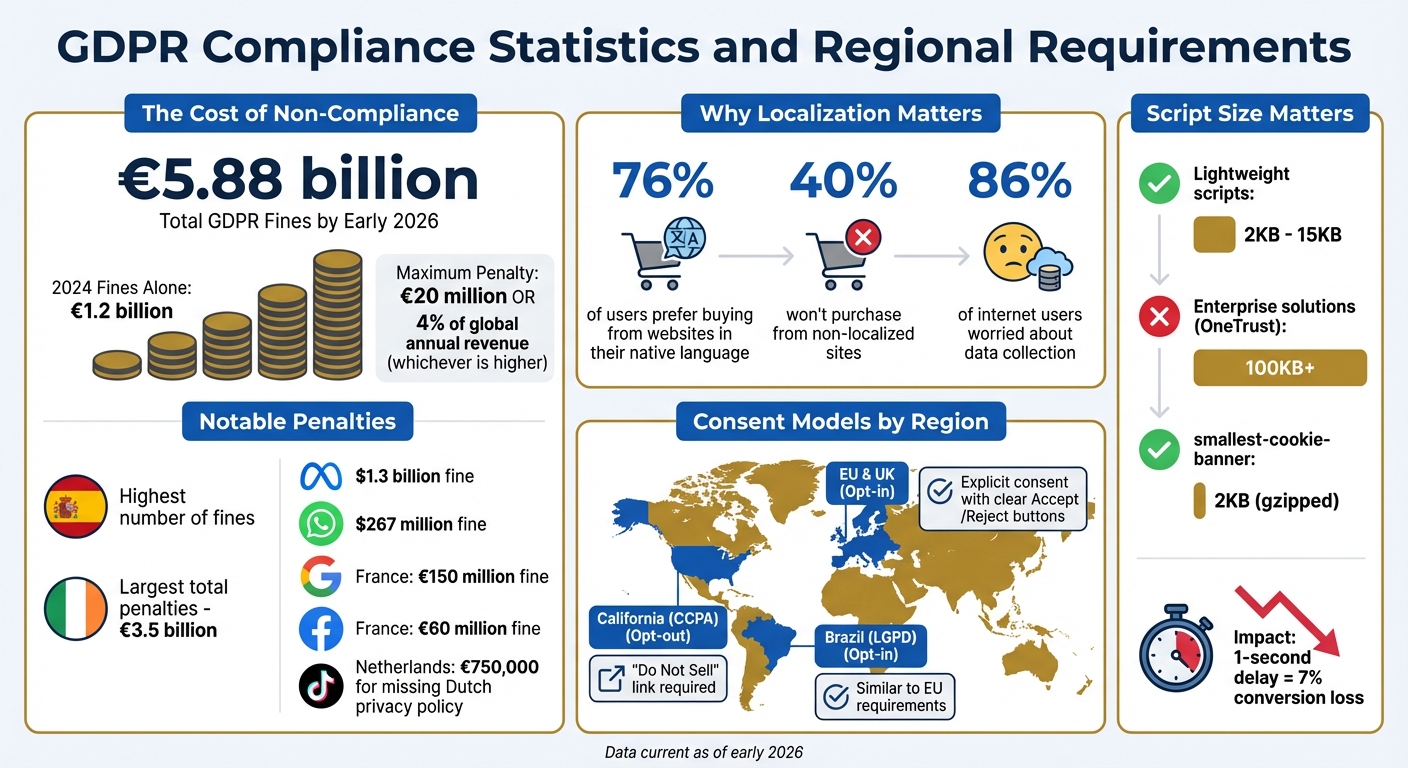
Websites targeting EU users must comply with GDPR, even if based outside the EU. Non-compliance can lead to fines of up to €20 million or 4% of global annual revenue. By early 2026, GDPR fines totaled €5.88 billion, with €1.2 billion issued in 2024 alone. Spain led with the highest number of fines, while Ireland imposed the largest penalties (€3.5 billion).
For multilingual websites, GDPR compliance for translated websites involves more than translation. Key challenges include managing geolocation, language preferences, and legal transparency. For example, privacy policies and consent forms must be available in users' native languages. Failing this, as seen in TikTok's €750,000 fine for not providing a Dutch privacy policy, can result in penalties.
Key GDPR Principles for Localization:
- Data Minimization: Collect only necessary data, such as location for language settings, without tracking additional behavior.
- Consent: Must be explicit and unambiguous, avoiding pre-ticked boxes or "dark patterns."
- Accountability: Maintain detailed records of user consent across all language versions.
Lightweight Localization Tips:
- Use small scripts (2KB–15KB) to maintain fast site performance.
- Block non-essential scripts until explicit user consent is given.
- Implement geo-targeted consent banners tailored to regional laws.
- Offer granular consent options for different data categories (e.g., functional, analytics).
Best Practices:
- Document all data processing activities, including third-party tools.
- Use automated tools to purge unnecessary data and maintain compliance.
- Test geolocation tools to ensure proper consent banners for each region.
Solutions like Heylingo help streamline GDPR-compliant localization by storing data within the EU, avoiding trackers, and offering flexible pricing for small businesses. With 76% of users preferring websites in their native language and 40% unwilling to buy from non-localized sites, achieving compliance while delivering tailored experiences is crucial for global success.
GDPR Fines and Regional Compliance Requirements 2024-2026
How to Implement Lightweight Localization with GDPR Compliance
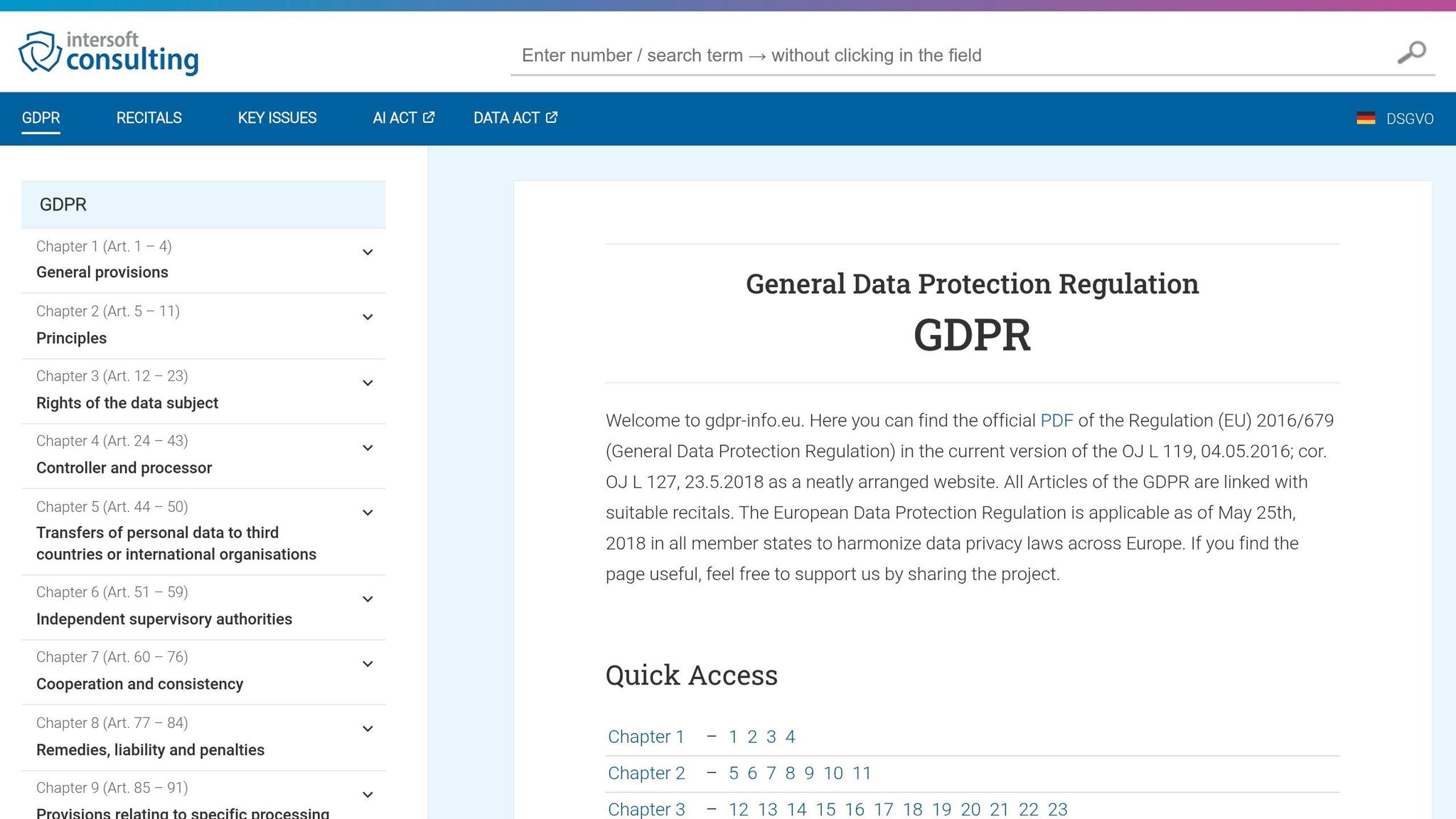
What Makes a Localization Script Lightweight?
A lightweight localization script typically ranges between 2KB and 15KB, has no external dependencies, and is loaded via a Content Delivery Network (CDN) to maintain optimal Core Web Vitals performance. For perspective, enterprise-level solutions like OneTrust can exceed 100KB, whereas alternatives such as smallest-cookie-banner are only about 2KB when gzipped.
The smaller size and efficient design of lightweight scripts mean they load quickly and integrate smoothly, making them a great choice for small to medium-sized businesses. This balance of performance and functionality ensures that GDPR-compliant features can be added without compromising page speed or user experience.
Steps to Implement GDPR-Compliant Localization
To ensure GDPR compliance, you’ll need to follow specific technical steps:
-
Block non-essential scripts by default: Use
type="text/plain"for scripts until the user provides consent. Once consent is granted, change the script type totype="text/javascript". This prevents tracking activities from occurring before explicit user approval. - Incorporate geo-detection: Identify users’ regions to apply the appropriate consent model. For example, users in the EU or UK require opt-in consent, whereas other regions may allow opt-out. Privacy-conscious methods, such as relying on timezone offsets, can be used for non-invasive geo-detection.
-
Use callbacks for dynamic control: Add
onAcceptandonRejectcallbacks to enable or disable tracking scripts dynamically based on user consent. - Offer granular preferences: Let users customize their consent by category - such as strictly necessary, functional, analytics, and marketing cookies - rather than forcing them into a single "Accept All" or "Reject All" decision. This approach is not just user-friendly but also critical for compliance. For instance, the French CNIL penalized Google (€150 million) and Facebook (€60 million) for making it difficult for users to reject cookies compared to accepting them.
Managing User Consent Across Different Regions
Regional regulations differ significantly, and your consent mechanisms must reflect these variations:
- EU and UK: Require explicit opt-in consent with clear Accept and Reject buttons.
- California (CCPA): Operates on an opt-out model, requiring a "Do Not Sell" link.
- Brazil (LGPD): Similar to the EU, mandates explicit opt-in consent.
To streamline this process, use automated language detection. Scripts can read browser language settings or <html lang> attributes to serve the correct localized consent message. Additionally, document every consent action - include timestamps and the accepted privacy policy version. This documentation is critical for audits.
Make it easy for users to manage their preferences by including a persistent settings icon in the footer. This allows them to withdraw or adjust consent at any time.
If your localization setup involves third-party services, such as IP-based region tracking from providers like ipinfo.io, ensure that these are clearly disclosed in your privacy policy. Obtain user consent before enabling such services. Ongoing consent management is a core part of maintaining GDPR compliance.
sbb-itb-8482ffa
Data Privacy Best Practices for Localized Experiences
Data Minimization Strategies for Localization
When tailoring content for specific regions, collect only the data necessary to achieve localization goals. For example, adjusting language or currency requires knowing the country or region - not precise GPS coordinates. Similarly, e-commerce platforms need a shipping address but not personal details like marital status or gender.
"The principle of 'data minimisation' means that a data controller should limit the collection of personal information to what is directly relevant and necessary to accomplish a specified purpose." - European Data Protection Supervisor
With 86% of internet users worried about how their personal data is collected, businesses need to prioritize minimizing the scope of data they gather. Opt for less invasive geolocation methods, such as detecting a user’s country through their IP address rather than relying on GPS tracking. To protect individual identities while analyzing trends, apply anonymization techniques like k-anonymity.
Automating data deletion is another key step. For instance, set systems to purge localized data from inactive accounts after six months. Implement role-based access controls to ensure that only authorized personnel can view or handle localized data. Non-compliance with GDPR’s data minimization rules can lead to severe penalties, including fines up to €20 million or 4% of global annual turnover. Accurate documentation of these practices is critical to prepare for audits and demonstrate compliance.
How to Document Data Collection Practices
Once data minimization is in place, thorough documentation becomes essential for meeting regulatory requirements. Start by maintaining a Record of Processing Activities (RoPA) that details the personal data collected for localization - such as IP addresses for geolocation - and the specific purpose of each data point, like adjusting currency or language settings. This level of documentation strengthens accountability under GDPR for localized content. Additionally, log any third-party vendors or sub-processors involved in handling personal data during localization.
Make sure privacy documentation is written in clear, straightforward language. Avoid legal jargon, as it can become even harder to understand when translated. A notable example: In 2021, the Dutch Data Protection Authority fined TikTok €750,000 for failing to provide its privacy policy in Dutch. This left Dutch-speaking users, including children, unable to understand how their data was being used. To avoid similar issues, hire professional legal translators for privacy policies instead of relying on machine translation tools, which often misinterpret legal terms.
Keep detailed consent logs that include timestamps, unique consent IDs, and the specific consent categories chosen by each user. When updating localized privacy policies, ensure all changes are synchronized across languages and include clear "last updated" dates in each local language. Finally, always use HTTPS to encrypt data in transit, safeguarding localized personal data from unauthorized access.
Testing and Verifying GDPR-Compliant Localization
Using Geolocation Testing Tools
Geolocation testing tools let you simulate access from specific regions, making it possible to check if GDPR-compliant cookie banners and privacy notices appear correctly for EU visitors. At the same time, these tools help ensure users in places like California see the appropriate messaging tailored to their region.
"The law requires actual enforcement of user choices, not just visual prompts." – WonderProxy
Start by testing multiple EU cities - such as Paris, Berlin, and Madrid - because geolocation databases can sometimes misclassify IP ranges. For better accuracy, use residential-style proxies instead of standard VPNs, as many websites block known VPN IP addresses. Platforms like BrowserStack or Sitepager provide global infrastructure for testing, while browser DevTools only simulate the Geolocation API, which doesn’t account for the IP-based detection most servers use.
A critical step involves verifying that clicking "Reject All" stops tracking cookies from being set in the browser. Automated scripts, proxies, and cloud-based platforms can help ensure consistent validation and ongoing compliance. Always conduct the final verification on your live site, as staging environments may behave differently when it comes to geolocation services. Proper testing ensures not only that consent banners appear correctly but also that they function in line with GDPR rules.
| Testing Method | Accuracy | Best For | Limitations |
|---|---|---|---|
| IP-Based (Proxies) | City/Country | Functional compliance, automation | May be blocked if using non-residential IPs |
| Cloud Platforms | Real-world conditions | Visual regression, SEO, performance | Higher cost than manual methods |
| Browser DevTools | API simulation only | Quick development checks | Does not test IP-based detection |
| VPNs | Country | Manual spot checks | Hard to automate; limited to one location at a time |
Validating Consent and Compliance Messaging
Once geolocation tests are complete, focus on verifying that consent messages meet legal requirements and build user trust. Ensure that banners are clear, responsive, and follow regional standards. This includes explicit, non-pre-checked options, clear "Accept" and "Reject" buttons, and links to detailed privacy policies. The stakes are high - Meta faced a $1.3 billion fine for GDPR violations, and WhatsApp was fined $267 million for similar issues.
Test scenarios like a California-based user with a Spanish browser setting or someone traveling between regions. Use browser developer tools to override geographic location and locale settings, such as setting de-DE for German, to see how your site responds. For right-to-left languages like Arabic, manually force RTL layouts in the browser inspector by adding dir="rtl" to the <html> tag to identify any CSS-related issues.
Make sure consent preferences carry over across sessions and devices. Use network throttling (e.g., "Slow 3G" in DevTools) to confirm that localized resources load properly without defaulting to fallback languages. Testing isn’t just a box to check - it’s essential for maintaining compliance and creating a trustworthy experience for users.
Cookie consent: mechanisms and practices for GDPR and ePrivacy compliance
How Heylingo Handles GDPR-Compliant Localization
Heylingo stands out as a practical and efficient solution for businesses seeking GDPR-compliant localization.
How Heylingo Ensures GDPR Compliance
Heylingo operates its translation services on servers located in Germany, ensuring that all data stays within the EU and aligns with GDPR requirements. This setup supports key GDPR principles, such as data minimization and transparency.
The platform takes privacy a step further by delivering translations without cookies, trackers, or third-party analytics. This means your consent management efforts can focus on other areas of your website.
"We deliver translations without cookies, trackers, or third-party analytics. A Data Processing Agreement (DPA) is available upon request." - Heylingo
For businesses needing formal documentation, Heylingo offers a Data Processing Agreement (DPA) upon request. This document outlines the legal responsibilities of both your business (as the data controller) and Heylingo (as the data processor), making it easier to meet compliance audits and contractual obligations.
Benefits of Using Heylingo for Localization
Beyond its strong GDPR compliance, Heylingo excels in performance and user-friendliness.
The lightweight script is designed to load asynchronously, ensuring it doesn’t block page rendering. This is crucial since even a 1-second delay in loading time can reduce conversions by 7%. Translations are delivered through a global CDN with smart caching, reducing server strain and providing consistent performance across the globe. Additionally, the system automatically detects and translates new content, eliminating the need for manual tagging.
A centralized dashboard gives you complete control over translations, allowing manual edits or adjustments. This feature is especially valuable for sensitive pages, such as privacy policies or terms of service, where precise language is critical.
Heylingo Features for Small and Medium Businesses
Heylingo works seamlessly with any CMS or platform, including WordPress, Shopify, Webflow, or custom HTML. For Shopify users, a dedicated plugin simplifies integration even further.
The pricing model is flexible, scaling with your content needs. Plans start at $10.80/month for approximately 20,000 words and go up to $74.50/month for around 200,000 words. All paid plans support over 30 languages and allow unlimited team members, making it easy to collaborate with translators, editors, and reviewers without additional costs. For those who want to explore the platform, a free tier is available, offering access to all features without requiring a credit card.
For dynamic or single-page websites, the script continuously scans for updates and can be refreshed manually. This adaptability means you can enhance your site's localization without needing to restructure its architecture - Heylingo fits right into your existing setup.
Conclusion
To build trust through localized privacy, it’s essential to focus on a few key principles. Under GDPR, the approach is clear: minimize data collection, ensure your localization provider avoids unnecessary sharing or storing of personal data, and stay transparent about how user information is managed.
The stakes are high - not just because of GDPR penalties, which can be severe, but also due to the business impact. Consider this: 76% of users prefer buying from websites in their native language, and 40% won’t even consider purchasing from sites that don’t offer their language. The right localization solution prioritizes privacy from the start. Look for providers that store data within the EU, steer clear of cookies and trackers, and provide clear Data Processing Agreements.
When privacy becomes a seamless part of your localization strategy, the rewards go beyond just meeting regulations:
"Data localization can enhance customer trust by ensuring users that their data is handled responsibly within their own country and in accordance with stringent privacy laws." - Cookie-Script
Empowering users to understand their privacy rights in their own language builds trust and encourages informed decisions. By adopting localization solutions designed with privacy in mind, you not only simplify compliance but also strengthen user confidence - an essential step in growing your global presence.
FAQs
Do I need GDPR compliance if my business is outside the EU?
If your business has visitors from the EU or processes their personal data, GDPR applies to you, even if you're based outside the EU. The regulation's reach is global, covering businesses that either offer goods or services to EU residents or monitor their online activities. No matter where you're located, you must comply to protect the privacy of EU users' data.
What user data can I collect for localization without breaking GDPR?
When collecting data like IP addresses, you can use it for localization purposes, such as displaying content in the user’s preferred language, showing prices in their local currency, or setting the appropriate timezone. However, it’s essential to ensure you have a lawful basis for this - whether that’s legitimate interest or explicit user consent. To comply with GDPR, make sure to prioritize user privacy by safeguarding their information and limiting data collection to only what’s absolutely necessary.
How can I prove consent across languages during an audit?
To demonstrate consent across different languages, it’s crucial to have all consent-related materials - like cookie banners and privacy policies - translated accurately into the languages your users prefer. Keep detailed records of consent, including timestamps and the specific language used at the time. Implementing a system that tracks this information ensures users were informed in their chosen language, offering clear proof if an audit occurs. Accurate translations combined with thorough logging are key to meeting GDPR requirements.