Google Translate vs Professional Translation Services
When deciding how to translate content, your choice depends on accuracy needs, time, and budget. Google Translate is fast, free, and works well for informal, low-stakes tasks like casual chats or travel phrases. However, it often fails with complex sentences, idioms, or specialized terms. On the other hand, professional translation services ensure precise, nuanced translations tailored to specific industries or audiences - ideal for legal documents, marketing materials, or technical manuals. While more costly and time-consuming, they minimize errors and maintain your brand’s credibility.
Quick Comparison
| Factor | Google Translate | Professional Translation Services |
|---|---|---|
| Translation Quality | Basic, struggles with context and tone | Accurate, handles complex and industry-specific content |
| Speed | Instant | Hours to weeks, depending on project size |
| Cost | Free | $0.08–$0.25 per word |
| Best Use Cases | Casual communication, informal needs | Business documents, marketing, technical content |
| Error Risk | Higher | Lower due to human expertise |
For quick, informal tasks, Google Translate is sufficient. For high-stakes content where accuracy matters, professional services are worth the investment.
Google Translate: How It Works and What to Expect
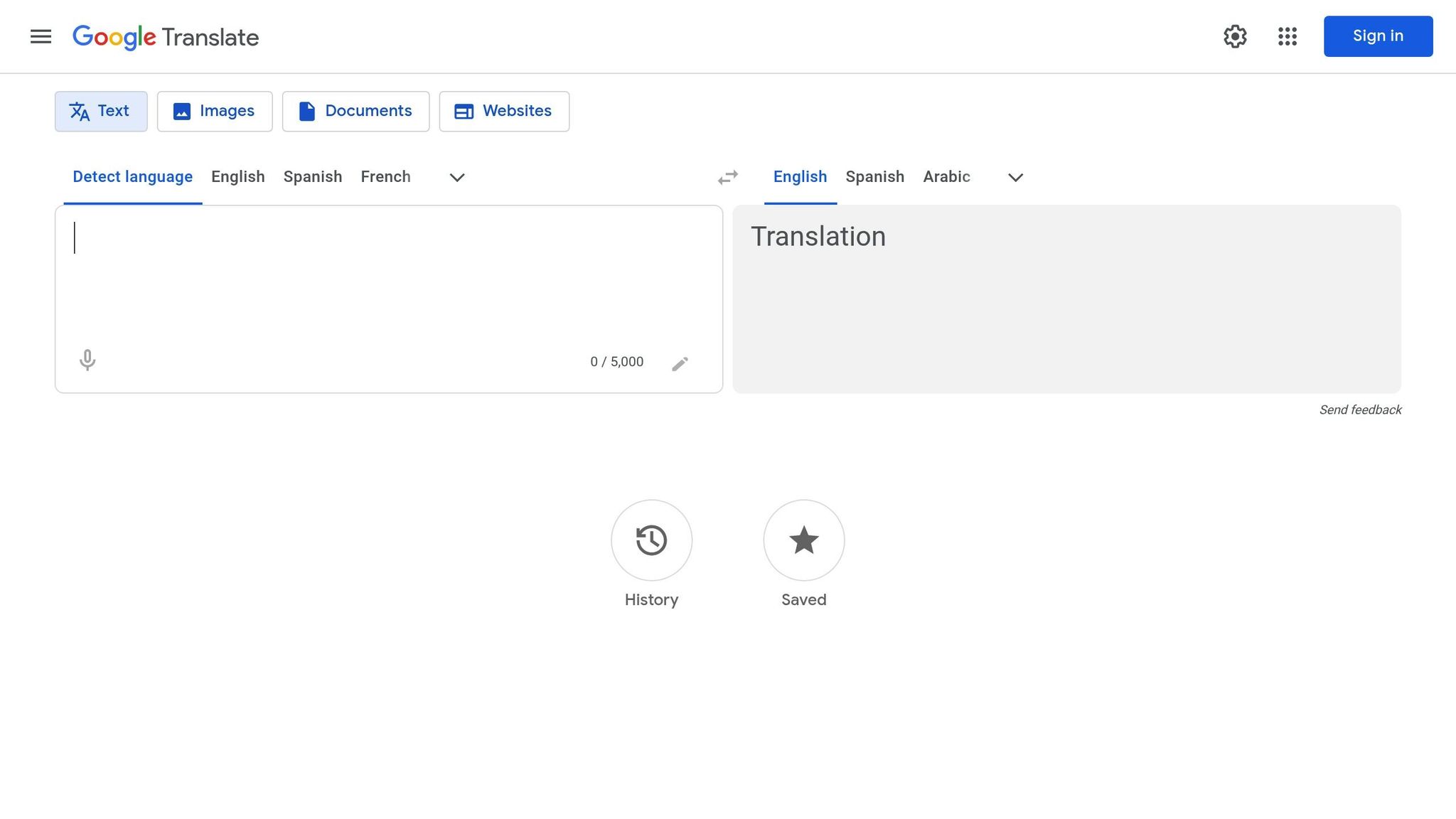
What is Google Translate?
Google Translate is a free tool that uses neural machine translation to convert text between languages. Instead of translating word by word, its neural networks analyze entire sentences to capture context, resulting in more natural translations.
This tool is powered by deep learning algorithms trained on vast datasets and supports over 130 languages. You can use it on its website, mobile app, or through its API. It offers features like text translation, voice input, image translation, and even real-time conversation mode.
These capabilities make it fast and versatile, though it’s not without its limitations.
Advantages of Google Translate
The biggest strengths of Google Translate are its speed and ease of use. It provides almost instant translations, which is perfect for quickly understanding a foreign-language email or figuring out a menu while traveling. Plus, it’s completely free and supports a wide variety of languages.
Google Translate works across devices - desktops, smartphones, and tablets. It also offers offline functionality for some languages, voice input for hands-free use, and image translation for signs or documents. For casual needs like social media posts or travel phrases, it’s incredibly handy. Features like pronunciation guides and alternative translations make it a helpful tool for language learners, too.
However, this convenience often comes at the expense of accuracy, especially for more complex language needs.
Drawbacks of Google Translate
While Google Translate excels in speed, it struggles with cultural nuances, idioms, and specialized terminology. This can lead to translations that feel awkward, overly literal, or even inappropriate. It also lacks the expertise needed for technical or industry-specific language, which can result in significant errors.
For critical or nuanced content, relying on a human translator is often the better choice.
Professional Translation Services: What They Offer
What Are Professional Translation Services?
Professional translation services rely on skilled human translators - native speakers or language experts - who not only translate words but also adapt meanings, cultural nuances, and tone to suit the target audience.
Unlike automated tools, these translators bring a deep understanding of language and often specialize in areas like legal, medical, technical, or marketing translation. They ensure the context, tone, and subtle language differences are handled with care, which is essential for effective communication across cultures. Generally, professional translation involves a multi-step process, including the initial translation, editorial review, and sometimes verification by subject matter experts. This thorough approach ensures accuracy, cultural relevance, and consistency in brand messaging.
Advantages of Professional Translation Services
Professional translation services stand out by delivering polished, context-specific content that automated tools simply can’t match.
One of their biggest strengths is accuracy. Human translators are adept at capturing nuances like idioms, cultural references, humor, and industry-specific jargon. They skillfully adjust language to avoid phrases that might be misinterpreted or carry unintended meanings.
Another key advantage is cultural adaptation. Translators customize content to fit local norms, holidays, measurement systems, and even color symbolism. For instance, when creating materials for an American audience, they’ll use dollars, Fahrenheit, and miles, while ensuring the tone and messaging align with American values and communication styles.
Specialized knowledge is another area where professional translators excel. Those with expertise in fields like medicine, law, or finance are well-versed in the technical terminology and regulatory nuances of their industries, significantly reducing the risk of costly mistakes.
Consistency in brand voice is also a hallmark of professional services. Translators often develop style guides and glossaries to maintain a uniform tone across all languages. This consistency not only builds trust but also reinforces your brand identity on a global scale.
Many professional services offer additional customization options, such as transcreation (creative adaptation for marketing), localization testing, and cultural strategy consultations. By working closely with clients to understand their goals and audience, these services provide translations tailored to specific business needs.
Drawbacks of Professional Translation Services
While professional translation services offer numerous benefits, they do come with some trade-offs.
One major drawback is cost. These services are generally more expensive than AI-powered tools, with pricing based on factors like word count and the translator’s expertise. This can make them less budget-friendly for large or highly specialized projects.
Turnaround time is another consideration. Unlike automated tools that provide instant results, professional translation involves a more time-intensive process, including reviews and quality checks, which can extend project timelines.
Effective project management and clear communication are also essential. Clients need to provide detailed context, reference materials, and specific instructions about tone, audience, and terminology preferences. Miscommunication or unclear expectations can lead to revisions and delays.
Finally, finding the right translator can be a challenge. Not all professionals have the same level of skill or experience, so you may need to spend time vetting credentials, reviewing samples, and coordinating efforts before starting a project.
Direct Comparison: Google Translate vs Professional Translation Services
Comparison Table
Here's a side-by-side look at how Google Translate and professional translation services stack up in key areas:
| Factor | Google Translate | Professional Translation Services |
|---|---|---|
| Translation Quality | Works well for basic phrases and casual communication but struggles with complex sentences, idioms, and context | Delivers highly accurate translations with a deep understanding of tone, context, and cultural nuances |
| Speed | Instant - translates text within seconds | Takes anywhere from a few hours to weeks, depending on the project's size and complexity |
| Cost | Free for all users | Typically ranges from $0.08 to $0.25 per word, depending on language pair and subject matter |
| Cultural Adaptation | Limited - literal translations often miss cultural norms or local preferences | Fully adapts content to fit local customs, values, and communication styles |
| Specialized Knowledge | Lacks expertise in specific industries; relies on general language patterns | Offers specialized translators for fields like legal, medical, technical, or marketing |
| Consistency | Can provide inconsistent translations for the same phrase | Ensures consistency in terminology and tone through glossaries and style guides |
| Best Use Cases | Ideal for quick translations, casual communication, and travel needs | Perfect for business documents, marketing materials, legal contracts, and website localization |
| Error Risk | Higher chance of mistranslations in technical or nuanced content | Lower risk due to human review and quality assurance processes |
| Availability | Accessible 24/7 from any internet-connected device | Requires scheduling and collaboration with professional translators |
The real differences become clear in high-stakes scenarios. While Google Translate might offer a literal translation, it often misses the cultural or contextual nuances critical for effective communication. A professional translator, on the other hand, ensures the message resonates with the intended audience, especially in specialized or sensitive content.
What to Consider When Choosing
Choosing between these options depends on your specific needs. Here's what to keep in mind:
Stakes: If you're translating a restaurant menu or casual text, minor errors won't matter much. But for legal, technical, or high-stakes content, even small mistakes can lead to serious consequences, including financial or legal risks.
Audience Expectations: Public-facing content, like product descriptions or marketing materials, needs to sound polished and align with your brand's voice. Internal documents, however, can tolerate less refinement.
Industry Regulations: Certain fields - like healthcare, legal, or finance - often require certified translations by qualified professionals to meet strict compliance standards.
Content Complexity: Automated tools work fine for straightforward content. But technical manuals, marketing copy with wordplay, or legal documents with precise language demand the expertise of human translators.
Time, Quality, and Budget: Google Translate is free and fast, making it great for quick, informal needs. Professional services take time and cost more, but they ensure the quality required for public-facing or high-value projects. Weigh the risks of mistranslations - like losing customers or damaging your brand - against the cost of hiring a professional.
Frequency and Volume: If you're handling daily, high-volume tasks like customer support messages, automated tools can save time. For occasional, high-impact projects like launching a product in a new market, professional services are worth the investment.
Language Pair: Google Translate performs better with common language pairs like English to Spanish. For less common combinations or languages with very different grammar, professional services are often more reliable.
Translation vs. Localization: If you need more than just a direct translation - like adapting humor, idioms, or cultural references for an American audience - professional localization is the way to go. Automated tools simply can't match that level of depth.
sbb-itb-8482ffa
Google Translate Vs Human Translator - Which is Better?
When to Use Each Option
Choosing the right translation method depends on the context and the stakes involved. Here's how to decide between automated tools like Google Translate and professional translation services.
Best Scenarios for Google Translate
Google Translate shines in fast, informal situations. Whether you're deciphering a menu while traveling, engaging in casual online chats, or skimming foreign-language documents to get the general idea, it’s a handy tool for personal use where perfect accuracy isn’t critical.
For low-stakes content, automated translation works just fine. Think about translating a recipe for personal use, understanding a hobby forum, or jotting down quick notes. It’s also useful for personal blog posts or private messages that won’t be scrutinized by a wide audience.
Another smart use? Preliminary review of documents. If you’re unsure whether a document requires professional translation, Google Translate can help you gauge its topic and importance. This way, you can prioritize what truly needs expert attention.
That said, it’s important to manage expectations. Google Translate often struggles with tone, humor, idioms, and specialized terminology. It’s great for quick, free translations to get the gist of something, but it’s not suited for content requiring precision or cultural sensitivity.
For anything more complex or high-stakes, professional translation services are the way to go.
When Professional Translation Services are Necessary
Professional translation becomes essential when accuracy and nuance are non-negotiable. Here are the key scenarios where human expertise is a must:
- Legal documents demand certified translators to ensure every term is correct. Missteps in contracts or legal papers can lead to costly disputes or even invalidate the document.
- Marketing and advertising require localization to connect with the audience. A clever tagline in English might not translate well - or worse, could offend - without careful adaptation. Professional translators maintain your brand’s voice while tailoring the message for local appeal.
- Website localization involves more than just translating text. It includes adapting details like currency symbols (e.g., $ for U.S. users), date formats (MM/DD/YYYY for Americans), measurement units (feet, pounds, Fahrenheit), and references that resonate with the target audience.
- Technical documentation needs precision. Manuals, software instructions, and engineering specs must be error-free. A mistranslation in a medical device manual or industrial guide could lead to safety risks or equipment damage.
- Financial and medical content comes with strict regulatory standards. Annual reports, clinical trial documents, and patient information leaflets often require certified translations to stay compliant with U.S. regulations, where even minor errors aren’t tolerated.
- Market expansion efforts call for professional services to avoid costly missteps. Product launches and regional campaigns need careful adaptation to ensure success in new territories.
- Customer-facing communications that represent your brand publicly - like email campaigns, product descriptions, and social media posts - should reflect professional quality to maintain trust.
For businesses with ongoing translation needs, professional services offer consistency. Translators can create glossaries and style guides to ensure all materials align with your brand’s tone and messaging.
When errors could lead to financial loss, legal trouble, safety concerns, or damage to your brand, investing in professional translation is a no-brainer. The upfront cost is a fraction of what you might lose if things go wrong.
Conclusion
Choosing between Google Translate and professional translation services depends largely on the nature of your content and the level of accuracy required. The key is to match the translation method to the importance of the task at hand.
For casual, low-stakes tasks - like skimming a foreign-language article, chatting online, or understanding the gist of a document - Google Translate works just fine. It’s free, quick, and easy to use, making it perfect for personal needs where small errors won’t cause any major issues.
However, when precision, tone, and cultural subtleties are essential, professional translation services are the way to go. Think legal contracts, marketing materials, technical guides, medical documents, or anything that represents your business. Mistakes in these areas can lead to legal troubles, harm your brand’s reputation, create safety risks, or even result in financial losses. Investing in professional expertise ensures you avoid costly errors and maintain your credibility.
Google Translate is great for understanding content, while professional translators excel at effective communication. One provides basic information; the other ensures your message connects with your audience. This distinction is crucial when deciding how to handle different translation needs.
For expanding into new markets, launching products, or meeting regulatory standards, professional services ensure your message resonates with local audiences while staying true to your brand and meeting compliance requirements. When your reputation or business success is on the line, shortcuts aren’t worth the risk.
Use Google Translate for quick, personal tasks where speed outweighs accuracy. Rely on professional translation for high-stakes projects where every word matters. Knowing when to choose one over the other can save you time, money, and unnecessary stress in the long run.
FAQs
How do I decide between using Google Translate and professional translation services for my project?
Choosing between Google Translate and professional translation services comes down to what your project requires. Google Translate is free, fast, and great for casual use or getting the gist of basic text. That said, it often falls short when it comes to accuracy, understanding cultural context, or keeping the tone consistent.
For more important tasks - like localizing a website or handling business communications - professional translation services are the way to go. They deliver precise translations, account for cultural subtleties, and can handle tricky language elements like idioms or specialized industry terms. While these services may take more time and come with a cost, the quality and dependability they offer are crucial for professional or high-stakes projects.
How do professional translation services ensure your brand message resonates across cultures?
Professional translation services depend on experienced human translators who are fluent in both the source and target languages. These professionals go beyond simple word-for-word translation - they grasp subtle cultural nuances, local customs, and audience preferences to make sure your content feels natural and connects with the target audience.
By tailoring tone, style, and messaging to fit cultural expectations, these services help preserve your brand's identity while steering clear of misunderstandings. This thoughtful approach ensures your message is clear, meaningful, and resonates effectively across diverse regions.
When should you choose professional translation services instead of Google Translate?
Professional translation services play a key role when precision, understanding of cultural nuances, and specialized knowledge are non-negotiable. This is especially true for tasks like translating legal documents, business contracts, marketing campaigns, certified materials, and highly technical or medical content.
Relying on tools like Google Translate in these cases can result in mistakes, misunderstandings, or even legal and compliance risks. Automated tools simply can't grasp context, tone, or subtle cultural differences the way a skilled human translator can. For critical or professional needs, human expertise ensures accuracy and tailors the message to connect with the intended audience effectively.