Track Language-Specific Traffic in GA4
Google Analytics 4 (GA4) automatically tracks visitors' browser or device language settings, giving you immediate insights into your audience's language preferences. This helps you understand how different language versions of your website perform and contribute to your goals, like user engagement and conversions. Here's what you need to know:
- Default Tracking: GA4 uses browser language settings to provide language data without requiring extra setup.
- Custom Dimensions: For more detailed tracking, you can create custom dimensions to capture specific language versions (e.g., based on subfolders like
/en/or subdomains likeen.example.com). - Key Metrics: Analyze metrics like engagement rate, event counts, and conversions by language to identify strengths and areas for improvement.
- Configuration Tips: Use a single GA4 property for all language versions to simplify analysis and avoid duplicate data.
- Advanced Analysis: Use regex filters and custom explorations in GA4 to group language variants and compare performance across languages.
Setting Up GA4 for Language Tracking
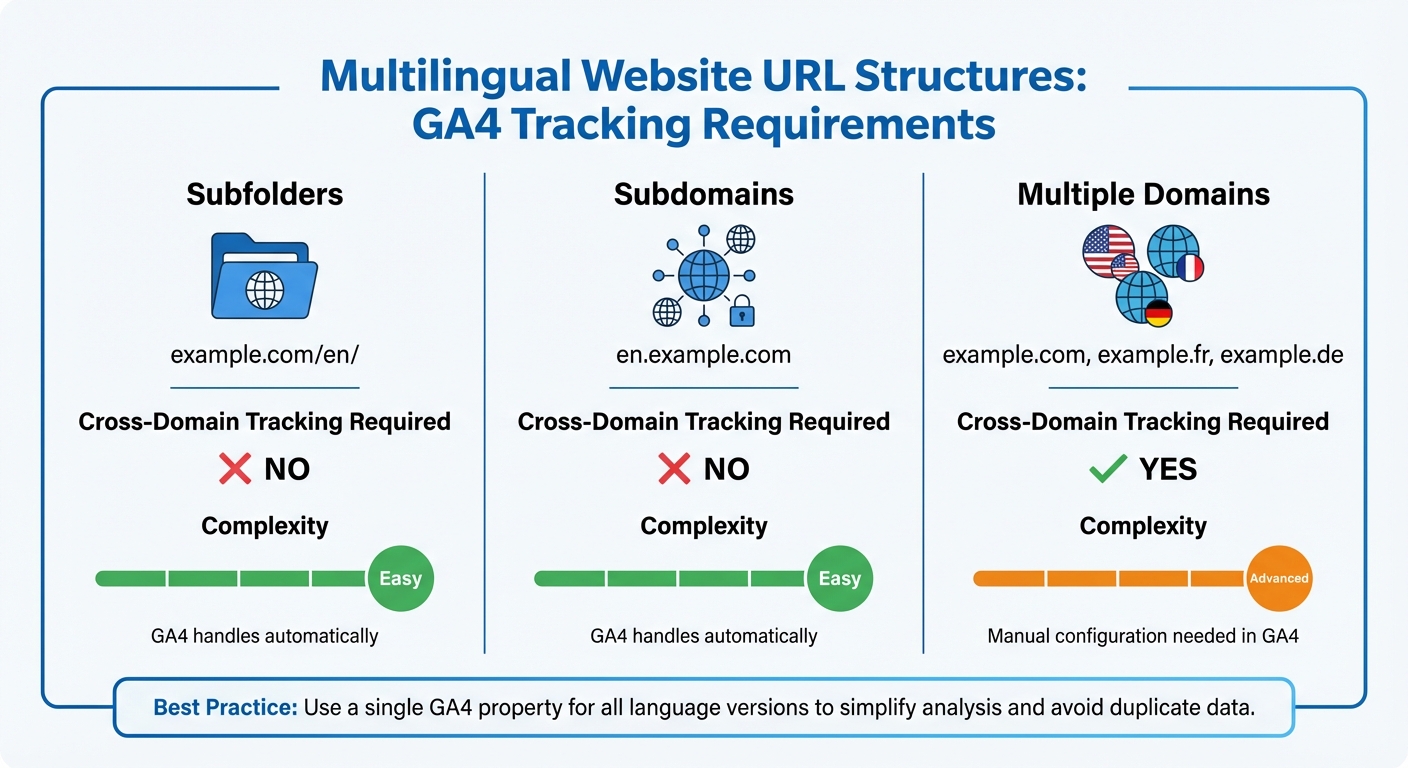
Multilingual Website URL Structures and GA4 Cross-Domain Tracking Requirements
To track language-specific traffic effectively, you need to ensure your GA4 property is properly configured. This involves reviewing your current setup and understanding how your multilingual website is organized.
Check Your GA4 Configuration
First, confirm that your GA4 property has an active data stream. You'll need Editor access or higher at the property level to make any necessary changes. Make sure every page of your site has either the Google tag (gtag.js) or a Google Tag Manager container installed.
Keep in mind that data collection can take up to 30 minutes. To confirm everything is working, check the Realtime report in GA4. One advantage of GA4 is that it automatically tracks user language preferences using the browser's Accept-Language header. This means you’ll start seeing language data without needing extra setup.
"Avoid creating separate properties or data streams for each language, as this adds unnecessary complexity to maintaining the GA4 setup." - Nick van Maaren, Freelance Ads & Analytics expert
Stick to using a single GA4 property for all language versions of your website. This simplifies your setup and allows for easier comparison of language performance.
Review Your Multilingual Website Structure
Your website’s URL structure plays a key role in tracking language-specific traffic. The three most common structures for multilingual sites are:
- Subfolders: example.com/en/
- Subdomains: en.example.com
- Multiple top-level domains: example.com, example.fr, example.de
Here’s a quick breakdown of how these structures impact tracking:
| Website Structure | Example | Requires Cross-Domain Tracking? |
|---|---|---|
| Subfolders | example.com/en/ | No |
| Subdomains | en.example.com | No |
| Multiple Domains | example.com, example.fr | Yes |
If your site uses multiple top-level domains, you’ll need to set up cross-domain tracking in GA4. Navigate to Admin > Data Streams > Configure tag settings > Configure your domains, and add each domain for your languages. Without this step, GA4 will treat visitors moving between domains as separate users, which disrupts your customer journey data.
For websites using subfolders or subdomains, cross-domain tracking isn’t necessary. GA4 handles these setups automatically, making them the easiest options for tracking multilingual traffic.
Once your GA4 property is configured and you’ve identified your website structure, you’ll be ready to dive into custom tracking setups in the next steps.
Using GA4's Built-In Language Reports
Google Analytics 4 (GA4) makes it easy to dive into language data by automatically tracking the language settings of your visitors' browsers. This means you can start analyzing language trends right away.
Find the Demographics > Language Report
To access language insights, log in to Google Analytics and head to the Reports section on the left-hand menu. From there, navigate to User > Demographics > Demographic details. Once you're in, click the drop-down arrow above the first column and switch the default view from Country to Language.
In this report, you'll see language data presented using ISO codes (like en-us, en-gb, or fr-fr). Alongside these codes, GA4 provides key metrics such as Users, Engaged sessions, Engagement rate, Event count, and Total revenue. Want to dig deeper? Use the "+" icon to add a secondary dimension, like Country, to see where speakers of specific languages are located.
For those who want a real-time view, check out the Realtime report. The Users by User property card offers a quick snapshot of language data as it happens.
Now, let’s talk about some of the challenges you might face with these default reports.
Know the Limits of Default Reports
While GA4's built-in language report is helpful, it does have some drawbacks. One major issue is how it categorizes languages. A single language, like English, can appear multiple times under different regional codes - en-us, en-gb, en-au, and so on. This fragmentation makes it harder to get a clear picture of your traffic.
"This is what is tricky with the usage of multilingual statistics by language, one language can have 10 entries." - Linguise
Another limitation is that the report reflects the visitor's browser language preference, not necessarily the language version of your site they are viewing. And keep in mind, the data only includes users who accept cookie consent banners and don’t use ad blockers. For more detailed, page-specific insights, you’ll need to either add secondary dimensions or create custom explorations tailored to your needs.
Setting Up Custom Language Tracking in GA4
GA4 automatically tracks browser language settings, but it doesn't record the specific language version of your site that users view. To address this, you can set up custom dimensions to capture language data directly from your site's URL or metadata.
Create Custom Dimensions for Language Data
First, figure out where your site's language information is stored. Is it in subfolders (like /fr/), subdomains (like de.example.com), or URL parameters? Once you know, you can pass this data to GA4 as a custom parameter.
To set this up in GA4, go to Admin > Custom Definitions and click Create custom dimension. Give it a clear name, such as page_language, and assign it to the event parameter that corresponds to the language data your tracking code sends.
"Custom dimensions and metrics are variables that you can create to track specific data about your website visitors."
Once registered, your custom dimension will appear in reports. Use GA4's Real-time reports to confirm that the language data is being captured correctly. Keep in mind that custom dimensions only work for data collected after they're created.
If you're using a localization tool like Heylingo to translate your site, ensure that your URL structure aligns with the custom dimension setup in GA4.
After setting up custom dimensions, you can take it a step further by grouping language variants for better analysis.
Apply Filters to Group Language Variants
To group different language variants, use regex filters. In GA4, click Add filter, select your custom language dimension, choose matches regex, and input a pattern like en-gb|en-us|en. Remember, regex in GA4 is case-sensitive by default, so if you want to ignore case, add (?i) at the start of your pattern.
In Google Tag Manager (GTM), create a Regex Table variable to map URL patterns (e.g., /en/, /en-us/, /en-gb/) to a single value like "English." Uncheck Full Matches Only in GTM to ensure subfolder variations are captured accurately.
With these filters in place, you can refine your data even more by creating detailed custom explorations.
Build Custom Explorations for Detailed Analysis
In GA4's Explore tab, start a blank exploration. Import your custom language dimension along with key metrics like Views, Conversions, and Event Count. Drag the language dimension into Rows and the metrics into Values to create a side-by-side performance view.
You can also set up custom segments to focus on specific language versions. This allows you to compare user behavior, conversion rates, and engagement patterns across different languages. Use the DebugView feature to ensure that your page_language parameter is working as intended.
sbb-itb-8482ffa
Using GA4 Data to Improve Your Multilingual Website
Once you've set up language tracking, the real advantage lies in using that data to make smarter decisions about localization. GA4 provides the insights you need to allocate resources effectively, refine translations, and evaluate the success of your localization efforts.
Find Your Top Languages by Traffic
Start by identifying the languages that drive the most visitors to your site. Using your custom language dimension, you can determine where localization efforts are making the biggest impact. To do this in GA4, navigate to Reports > User > Demographic > Demographic details and switch the primary dimension to "Language." This will show traffic volume by language. You can also create a free-form report with "Language" as the row and metrics like "Total users", "Engagement rate", and "Conversions" as values.
For a deeper dive, add "Country" as a secondary dimension. This allows you to cross-reference language preferences with geographic locations, helping you spot regional differences. For instance, you can distinguish between Spanish speakers in Spain and those in Mexico.
"You can perform well in Spanish language but not very well in Spain if you have all your Spanish visitors from South America." - Linguise
Focus on languages with high traffic but lower engagement or conversion rates. These represent opportunities to improve through better translations or more culturally tailored content. Compare language metrics to identify where engagement levels differ and why.
Compare Performance Metrics Across Languages
Analyzing traffic, engagement, and conversion metrics can help you uncover performance gaps. In GA4, engagement rate has replaced bounce rate as a key indicator of how well your content resonates with users.
Use the Comparisons tool in standard reports to evaluate subsets of data side by side. For e-commerce sites, comparing revenue by language can help you assess the return on investment (ROI) for your translations.
| Metric Category | Key Metrics to Compare | What It Tells You |
|---|---|---|
| Traffic | Total users, Sessions, Views | Which languages have the highest reach and potential for growth |
| Engagement | Engagement rate, Engaged sessions, Event count | Whether your translations and content meet user expectations |
| Conversion | Conversions, User conversion rate, Total revenue | The impact of localized calls-to-action on your business goals |
If you’re using a tool like Heylingo to manage translations, these metrics can guide you on which language versions might need manual adjustments. Use this data to refine your localization strategy before rolling out updates.
Test and Track Localization Changes
Once you've made updates to your translations, it’s essential to measure their impact using GA4. With GA4 custom explorations, you can directly compare metrics from before and after your localization changes. For instance, create a Path Exploration in the Explore tab to visualize how users navigate your site after landing on a specific language version. This is especially helpful for tracking key actions like checkout processes or lead generation funnels.
"Collecting data in one property is the best way to track multilingual websites... You can create explorations in GA4 that give you all the answers you need. You can configure them based on the setup of your site, languages and conversions." - Jeff Sauer, Founder, Data Driven U
To A/B test translation updates, use the utm_content parameter to differentiate between variations and track their performance. Compare metrics like engagement rate and session conversion rate between the different versions. You can also apply filters to focus on localized pages.
Conclusion
Tracking language-specific traffic in GA4 can help you make smarter decisions for your multilingual website. By creating custom dimensions like page_language, you can identify which language versions are driving user engagement and conversions - going beyond just their browser language settings. This distinction is key to understanding the actual user experience versus their initial intent. Combining custom dimensions with clear tracking methods lays the groundwork for continuous improvement.
By consolidating language data into a single GA4 property, you can get a comprehensive view of your global performance. At the same time, you can use custom explorations and filters to analyze specific languages in detail. This method simplifies your analytics setup while keeping it effective.
If certain pages show high bounce rates due to mismatched language targeting, it’s a clear sign they need attention.
"If you find that users who click on Spanish ads have a high bounce rate and/or low conversion rate, you may want to stop driving those users to an English-language site and instead invest in creating a site in Spanish."
- Google Analytics Help.
Extending your data retention to 14 months allows you to track and compare language performance year-over-year. With GA4 offering up to 50 event-scoped custom dimensions, you have plenty of flexibility to monitor the metrics that matter most for your multilingual strategy.
If you’re using Heylingo for translations, these GA4 insights can pinpoint which language versions need improvement and where your localization efforts are succeeding. Leverage Heylingo alongside GA4 data to fine-tune your language versions and turn international visitors into loyal customers.
FAQs
How do I track traffic for different language versions of my website in GA4?
To monitor traffic for the various language versions of your website in Google Analytics 4 (GA4), you have two main options: using the built-in language dimension or setting up a custom user property for more control.
GA4 automatically captures the browser language (e.g., en-US, fr-FR), which you can find under User > Language in your reports. If you need more granular tracking, you can create a custom dimension in GA4’s admin settings. By doing this, you can pass specific language values - such as the page’s language or a language identifier from the URL segment - through your global site tag (gtag.js). This setup enables you to dive deeper into analyzing traffic, conversions, and user behavior for each language version of your site.
After configuring this, verify the data using GA4’s Realtime or DebugView reports. From there, you can build custom reports or apply filters to focus on specific language traffic. This approach helps you gain insights into your multilingual audience and refine your strategies for each locale.
What are the advantages of using a single GA4 property for a multilingual website?
When you use a single GA4 property, you can bring together all the language versions of your website into one unified dataset. This setup simplifies analyzing performance across different regions, comparing traffic for various languages, and tracking user journeys effortlessly across subdomains or language-specific streams.
Centralizing your data in this way offers clearer insights into how users engage with your multilingual site, helping you make smarter decisions to improve their experience.
How can custom dimensions improve language-specific tracking in GA4?
Custom dimensions let you track language data that GA4 doesn’t automatically capture. For instance, you can create a user-scoped custom dimension (like "site language") to save a visitor’s preferred language for all their future sessions and events. On the other hand, an event-scoped custom dimension (like "page language") logs the language for specific actions on your site. This gives you the ability to analyze metrics such as sessions, conversions, or engagement by language, helping you understand which ones perform the best.
You can pull language data from your site’s localization tools - like Heylingo’s automatic language detection - and send it to GA4 using tools such as GTM or the gtag command. Once configured, this data lets you create language-specific audiences, track performance by language, and identify trends across different regions. These custom dimensions turn language into a powerful analytics tool, offering detailed insights and actionable data for managing your multilingual website.