How To Translate Brand Terminology Effectively
Translating brand terminology isn't just about switching words - it's about ensuring your brand's identity stays intact across languages and regions. Why? Because 76% of consumers prefer buying products with information in their native language, and 40% won’t buy from websites that don’t offer it. Missteps, like Chevrolet’s "Nova" (which means "it doesn’t go" in Spanish), can damage trust and require costly fixes.
To get it right:
- Create a Brand Glossary: Identify key terms (product names, slogans, jargon) and provide context to avoid inconsistencies.
- Set Translation Guidelines: Define tone, style, and formatting rules to align with your brand voice in every market.
- Translate and Validate: Work with experts, test translations in context, and ensure they resonate locally.
- Use Technology: Tools like Heylingo streamline translations and maintain consistency.
Investing in clear processes and tools ensures your brand remains recognizable and trustworthy worldwide.
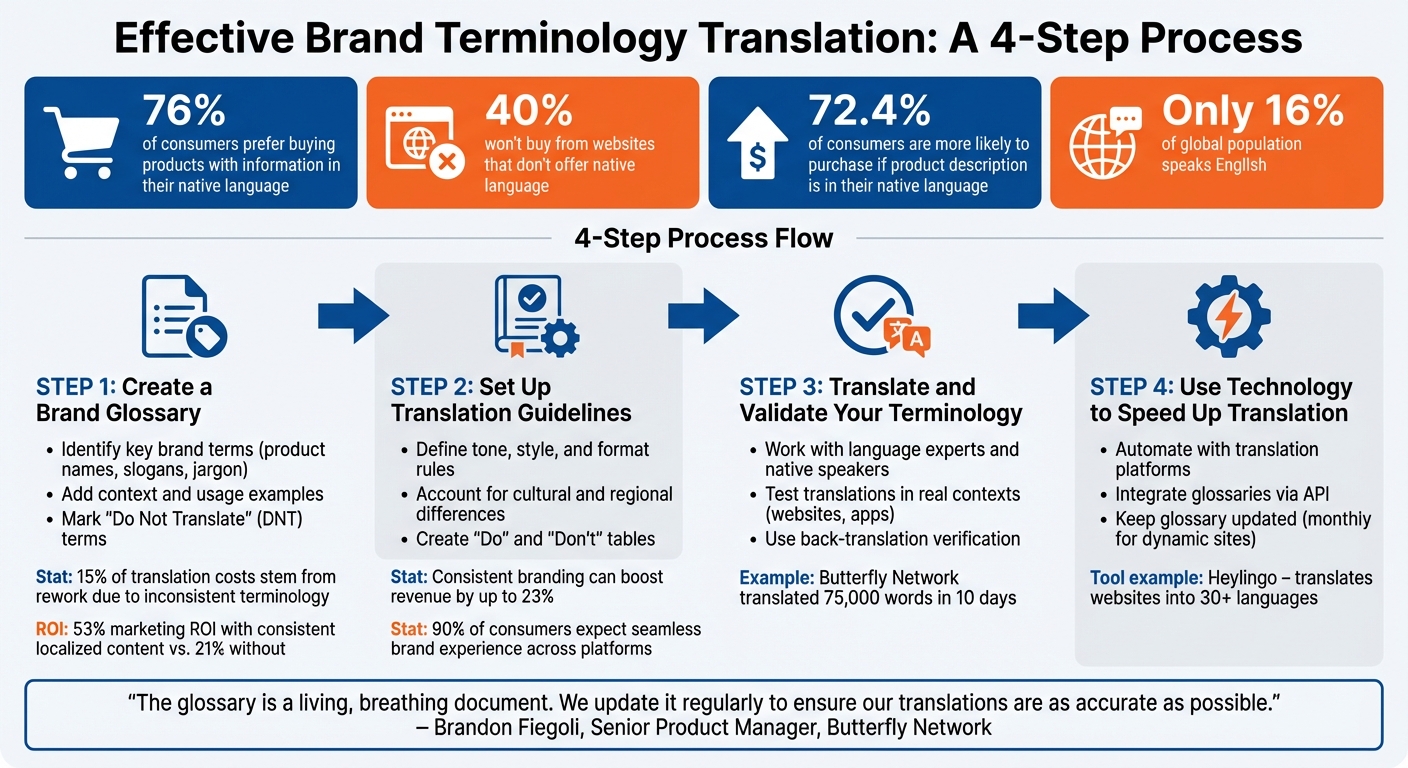
4-Step Process for Translating Brand Terminology Effectively
AI Translation: How to Use a Glossary & Style Guide for On-Brand Results
Step 1: Create a Brand Glossary
A brand glossary serves as the cornerstone for maintaining consistency in how essential terms are translated. Without one, translators might interpret key terms differently, leading to inconsistencies that dilute your brand identity. Did you know that about 15% of translation project costs stem from rework, and inconsistent terminology is often the main reason?. Companies that stick to consistent, on-brand localized content see a marketing ROI of 53%, compared to just 21% for those that don’t. To build your glossary, start by identifying critical terms and providing clear context.
Identify Your Key Brand Terms
To ensure consistency, begin by reviewing your website copy, UI text, marketing materials, and technical documents to identify the most impactful terms. Tools like frequency calculators can help pinpoint commonly used words - these high-frequency terms are perfect candidates for your glossary. Focus on four main categories:
- Brand-specific phrases: Product names, slogans, and taglines.
- UI/UX text: Labels like "Submit" or "Cancel."
- Industry jargon: Technical or legal terms specific to your field.
- Non-translatables: Trademarks, hashtags, or company names that should remain in English.
Don’t forget to include "no-go" terms - competitor names, outdated phrases, or any words that should never appear in translations. Skip over common stop words and prioritize terms that are either ambiguous or unique to your brand. Finally, involve internal stakeholders or local market experts to review your list and ensure it aligns with your audience’s needs.
Add Context and Usage Examples
Context is everything when it comes to translation. A term like "experience" could refer to an adventure, a customer interaction, or a software interface, depending on the situation. To avoid misunderstandings, provide a clear definition, specify the part of speech (e.g., noun, verb, adjective), and include a usage note that explains where and how the term is used. For example, if "tab" refers to a UI element rather than a physical folder tab, make that distinction clear.
"The glossary is a living, breathing document. We update it regularly to ensure our translations are as accurate as possible." - Brandon Fiegoli, Senior Product Manager, Butterfly Network
In 2024, Butterfly Network partnered with Smartling to expand internationally. By creating detailed linguistic assets and treating their glossary as a dynamic resource, Brandon Fiegoli and his team translated an impressive 75,000 words of content in just 10 days. To avoid costly errors, mark terms that should remain untranslated - like brand names or email addresses - with a "Do Not Translate" (DNT) flag. This upfront clarity minimizes rework, preserves your brand voice, and improves the accuracy of machine translation tools that rely on glossary context. With a well-crafted, context-rich glossary in place, you're ready to move on to defining detailed translation guidelines in the next step.
Step 2: Set Up Translation Guidelines
Once your glossary is ready, the next step is creating translation guidelines to maintain a consistent brand voice across multiple languages like English, Spanish, and Japanese. These guidelines help translators use key terms effectively while preserving your brand's identity. Consistent branding is no small matter - it can boost revenue by up to 23%, and 90% of consumers expect a seamless brand experience across all platforms and devices. To get started, outline your brand's tone, style, and formatting rules to ensure every translation aligns with your messaging.
Define Tone, Style, and Format Rules
Your translation guidelines should build on your glossary to reflect your brand’s personality in every localized piece. Start by documenting your brand’s tone - whether it’s friendly, professional, witty, or formal - and set clear style rules. Decide on preferences like active versus passive voice, first versus third person, and even punctuation choices, such as whether to use the serial comma. Formatting should also follow U.S. standards, including MM/DD/YYYY for dates, 12-hour clock times (e.g., 3:30 PM), USD currency (e.g., $49.99), and imperial units.
"A translation style guide isn't just about getting the words right. It's also about creating a consistent, recognizable experience in every language and culture you enter - one that resonates with your target audience." – Pamela Ghosal, Director, Brand & Communications, Phrase
To avoid confusion, include "Do" and "Don't" tables with concrete examples. For instance, if your brand uses "organize" instead of "organise", make this explicit. If you prefer sentence case over title case for headings, show exactly how that should look. Treat these guidelines as a living document - update them regularly to reflect shifts in your brand identity or market trends.
Account for Cultural and Regional Differences
While your brand should feel consistent globally, adapting to cultural nuances is crucial for building trust in local markets. For example, Pampers uses "diapers" in the U.S. but switches to "nappies" in the U.K. and Australia to align with local terminology and avoid losing search traffic to competitors. Similarly, when translating financial content for Spain, you might replace the U.K.’s OBIE (Open Banking Implementation Entity) with Spain’s BdE (Banco de España) to provide a more relevant local equivalent.
Define the appropriate level of formality for each market - Argentine Spanish may allow for informal pronouns, while German audiences might expect formal address. Address gender and inclusivity with clear instructions, especially in languages like Spanish or German where gendered nouns are common. If your brand prioritizes gender-neutral communication, make this a key part of your guidelines. Collaborate with in-country experts, including native speakers and local employees, to review your guidelines and flag any cultural taboos, symbols, or idioms that could be misinterpreted or offensive. These cultural adjustments, combined with your glossary and style guide, will ensure your brand feels authentic and relatable across the globe.
sbb-itb-8482ffa
Step 3: Translate and Validate Your Terminology
Once your glossary and translation guidelines are ready, it’s time to translate your brand terms and make sure they resonate with local audiences. This step ensures your messaging feels authentic and relevant in each market. Combining expert translation with rigorous testing is crucial before anything goes live.
Work with Language Experts
Accurate brand terminology translation requires professional linguists who understand the subtleties of language and the specific context of your target market. A reliable method involves pairing a translator with expertise in your field and a native-level proofreader for bilingual proofreading and back-translation verification. For technical or industry-specific terms, assign these to subject-matter experts to ensure precision and compliance with standards.
"The glossary is a living, breathing document. We update it regularly to ensure our translations are as accurate as possible." – Brandon Fiegoli, Senior Product Manager, Butterfly Network
Back-translation is a valuable tool to confirm that the original meaning remains intact. To measure translation accuracy, track metrics like "errors per 1,000 words." This can help identify patterns and areas for improvement. Interestingly, around 15% of translation project costs stem from rework caused by inconsistent terminology.
Once the translations are complete, the next step is to validate them in real-world applications.
Test Translations in Real Contexts
Testing translations in live environments - such as websites or mobile apps - can uncover issues that aren’t obvious in spreadsheets. In-context testing ensures that design elements, layout changes, or technical constraints haven’t altered the intended meaning. For example, a term that works perfectly in a glossary might be too long for a button label or could carry unintended implications when paired with other content.
Local experts or employees in the target market play a key role in this process. They can validate whether the translations feel natural and culturally appropriate, as well as identify nuances like regional slang, outdated expressions, or conflicting terminology that even skilled translators might overlook. To make their feedback actionable, provide these reviewers with a checklist that outlines style preferences and cultural considerations.
Finally, use automated Language Quality Assurance (LQA) tools to verify that all pre-approved glossary terms have been applied correctly. Combining expert reviews with automated checks ensures your translations are accurate and ready for launch.
Step 4: Use Technology to Speed Up Translation
After validating your translations, it's time to bring in technology to streamline the process. Advanced translation tools help automate repetitive tasks, minimize human error, and ensure consistent use of your approved glossary terms. These tools not only save time but also make the entire process smoother. For example, platforms like Heylingo simplify website translations by focusing on automation.
Simplify Website Translation with Heylingo
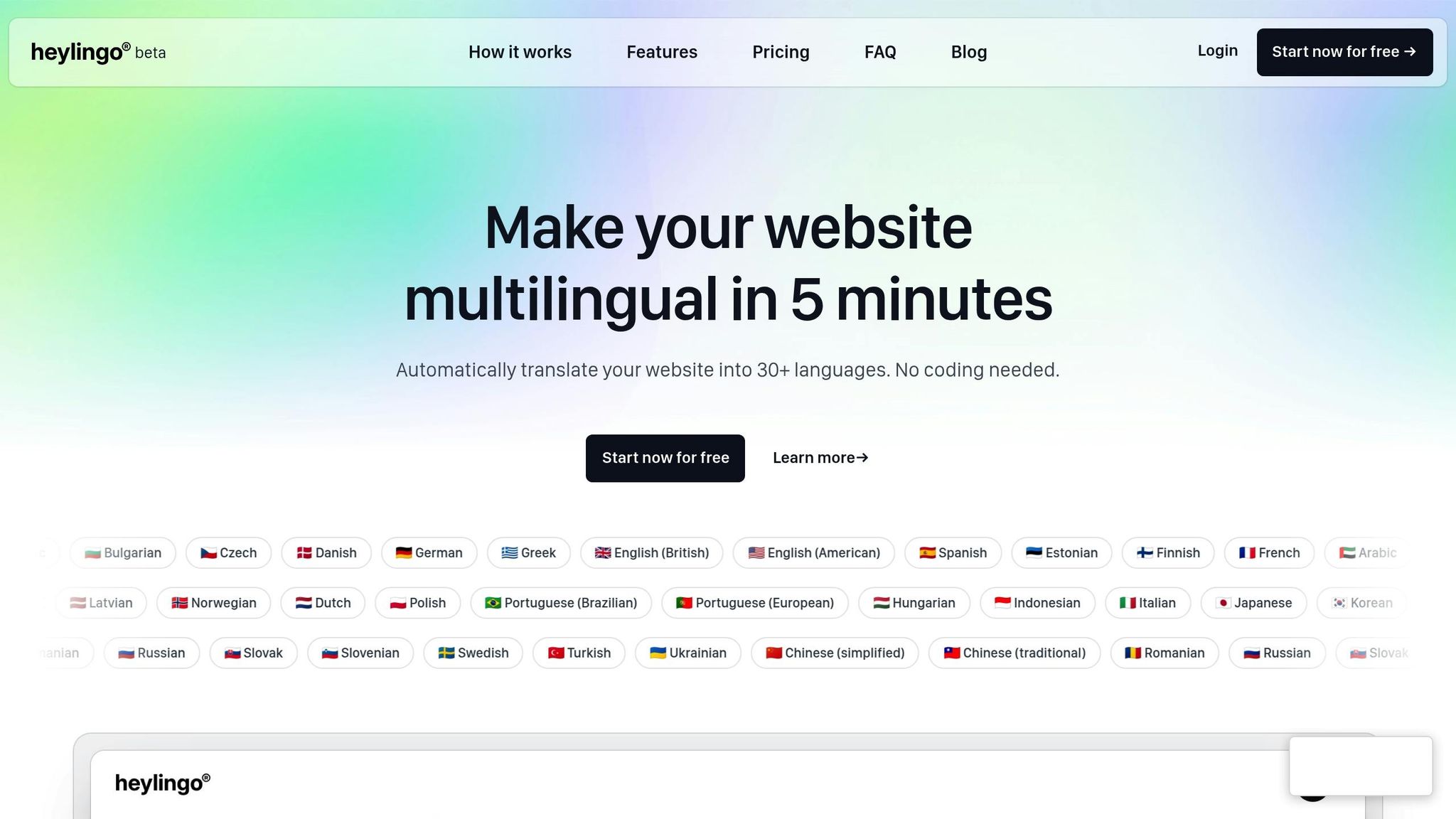
Heylingo takes the hassle out of website localization by automatically translating your site into over 30 languages - without requiring any coding or technical expertise. Acting as a real-time translation layer, it detects content on your website and instantly serves localized versions. This eliminates the need for manual file exports, transfers, and re-imports, which are often time-consuming and prone to delays.
With Heylingo's user-friendly dashboard, you can review and tweak translations to ensure they align with your brand's voice. This is especially useful for managing specific terms, like keeping product names untranslated or adapting taglines to better resonate with different audiences. On top of that, Heylingo ensures GDPR compliance, which is crucial for handling data from international customers.
Here’s a compelling statistic: 72.4% of consumers are more likely to purchase a product if the description is in their native language. Yet, only about 16% of the global population speaks English. This highlights the importance of localized translations in reaching a broader audience.
Keep Your Glossary Up to Date
Once you've automated the translation process, integrating your glossary becomes essential for maintaining consistent brand terminology. Modern tools allow you to embed glossaries that include definitions, context, and "Do Not Translate" (DNT) flags. This ensures that both human translators and AI systems stick to your approved terms rather than defaulting to generic translations.
A real-world example of this approach comes from Butterfly Network in late 2024. Led by Senior Product Manager Brandon Fiegoli, the team integrated comprehensive linguistic assets and an updated glossary via API connections. This enabled them to translate 75,000 words of content in just 10 days, culminating in a full international launch within six weeks.
To keep your translations accurate and relevant, make it a habit to review your glossary regularly. For dynamic websites, aim for monthly updates; for static ones, annual reviews should suffice. These updates are essential for adding new terms, removing outdated ones, and ensuring that your translations evolve alongside your brand. By doing this, you can maintain high-quality translations without needing to retranslate your entire site.
Conclusion
Effectively translating brand terminology requires thoughtful planning, teamwork, and leveraging the right tools. Start by creating a detailed glossary that includes your key terms, along with their context and examples of how they should be used. Pair this with clear translation guidelines that outline your brand's tone, style, and any cultural nuances. This initial groundwork helps avoid costly mistakes and ensures your translation projects stay on track.
Incorporating expert reviews and in-market validation ensures your translations connect with diverse audiences while maintaining your brand's voice. Brands that focus on consistency see a marketing ROI of 53%, compared to just 21% for those that overlook this critical step.
"The glossary is a living, breathing document. We update it regularly to ensure our translations are as accurate as possible".
Once these foundational steps are in place, technology can make the process even smoother. Tools like Heylingo simplify website translation into 30+ languages, giving you the ability to review and fine-tune terminology through an intuitive dashboard. This is crucial, as most consumers prefer to shop for products with descriptions in their native language, yet only about 16% of the global population speaks English.
FAQs
Why is a brand glossary important for accurate and consistent translations?
A brand glossary plays a key role in keeping your brand voice consistent, even when communicating across multiple languages. It serves as a reference for translators, offering a pre-approved list of terms to ensure that product names, key phrases, and messaging remain uniform and easily recognizable.
With a glossary in place, you can avoid inconsistent wording that might confuse your audience or weaken your brand identity. It also makes the translation process smoother by cutting down on errors and reducing the need for repeated revisions. For companies aiming to grow internationally, a thoughtfully designed glossary is an essential part of successful localization efforts.
How do cultural differences affect the translation of brand-specific terms?
Cultural differences play a big role in how brand-specific terms are perceived across markets. A phrase that feels engaging or positive in one region might come across as confusing, inappropriate, or even offensive in another. This is especially true for idioms, humor, or references tied to local traditions, which often don’t translate well and can lose their intended meaning or impact.
To strike the right balance between consistency and cultural sensitivity, brands should create translation style guides and glossaries that offer clear context and locally relevant examples. These resources help translators match the tone, phrasing, and messaging to local expectations while staying true to the brand’s identity. Tools like Heylingo can make this process easier, offering features to review and refine translations so your brand connects with audiences around the globe.
How does technology simplify translating brand-specific terminology?
Technology has transformed the way translations are handled, making the process quicker, more precise, and uniform. Tools like cloud-based translation platforms bring everything a translator needs - glossaries, style guides, and terminology databases - into one centralized location. This ensures everyone is working with the most current and consistent resources. Features powered by AI, such as translation memory, terminology management, and smart suggestions, take efficiency to the next level. These tools can suggest pre-approved terms, flag inconsistencies, and automatically apply language tailored to a brand's identity.
Heylingo goes even further by embedding a robust translation engine directly into your website. It seamlessly integrates your brand’s glossaries and gives you the ability to review and tweak translations through an intuitive dashboard. This setup not only keeps your brand's tone and messaging consistent across languages but also slashes the time and effort needed to localize your content effectively.