Why Your Website Needs Multiple Languages in 2025
Want to grow your business globally? Your website needs to speak your audience's language.
In 2025, relying solely on English for your website is a missed opportunity. Here’s why multilingual websites are essential:
- Global Reach: Over 76% of online users prefer browsing in their native language, and 40% won’t buy from sites that don’t offer it.
- Trust and Loyalty: People feel more confident purchasing when content is in their language - 65% of users prioritize this.
- SEO Advantages: Search engines favor region-specific content, helping you rank higher in international markets.
- AI-Powered Solutions: Tools like Heylingo make translations faster, easier, and more cost-effective than ever.
How To Reach a Global Audience With a Multilingual Website
Key Benefits of Offering Multiple Languages
Adding multilingual support to your website can unlock a range of business opportunities that go far beyond basic translation. Companies that take this step often experience increases in revenue, stronger customer relationships, and better online visibility.
Expand Market Reach and Revenue
Breaking language barriers opens doors to new markets. Research shows that 76% of online consumers prefer websites in their native language, while 40% refuse to buy from sites that don't offer content in their language. Additionally, 56% of shoppers prioritize language over price when making purchasing decisions. By providing content in multiple languages, businesses can instantly connect with billions of potential customers worldwide.
Multilingual pages often perform better than English-only versions, especially in international markets. Companies frequently report higher conversion rates on these pages. When customers fully understand product details, instructions, and terms in their own language, they’re more likely to feel confident about completing a purchase. This clarity naturally leads to higher sales and better customer satisfaction.
Build Trust and Brand Loyalty
Offering content in a visitor's native language is a powerful way to build trust and long-term loyalty. In fact, 65% of people prefer reading in their native language, even if the translation isn't perfect. As Nick McGuire, an E-commerce Specialist and Blogger, explains:
"When your site is available in multiple languages, you attract the attention of an international market. You also become identified as a global brand which elevates your status and improves your reputation. Consumers tend to trust global brands more than ones that are only known locally."
Localized content creates confidence by addressing key details like payment instructions, return policies, warranties, and customer support in the user's language. This reduces uncertainty and helps customers clearly understand their rights and the company’s commitments. Supporting this, 72.1% of consumers spend most or all of their time on websites in their own language. These trust-building elements also contribute to better search engine rankings, further enhancing your site’s visibility.
Boost SEO and Regional Discoverability
Search engines increasingly reward websites that provide localized content tailored to specific regions. This goes beyond simple translation - it involves adapting content to match the cultural and linguistic nuances of each audience. Regional search engines like Baidu, Yandex, and Naver favor websites offering authentic local content, often leading to higher rankings and more organic traffic in those markets.
Multilingual SEO also allows businesses to target keywords with varying search volumes and competition levels across languages. Technical strategies, such as using hreflang tags, country-specific domains, and localized meta descriptions, signal to search engines that your content is designed for diverse audiences. This approach not only improves regional discoverability but also boosts the likelihood of your content being shared and linked within local networks, amplifying its reach.
Localization Challenges and How AI Solves Them
Tackling localization challenges with AI has become a game-changer for businesses aiming to expand their global reach in 2025. While multilingual websites clearly offer a competitive edge, many companies face hurdles in creating and maintaining localized content. Traditional translation methods often slow things down, but AI-powered solutions are revolutionizing the process.
Common Localization Challenges
Cost and Resource Constraints
Using professional translators for large websites can be expensive, especially when factoring in ongoing updates and maintenance.
Time-Intensive Workflows
Traditional translation processes involve multiple manual steps, which can delay the rollout of global content.
Consistency Across Languages
Keeping translations aligned with updates in the primary language is an ongoing issue. If updates aren’t properly managed, it can lead to outdated or inconsistent information, damaging the user experience and eroding trust in the brand.
Technical Integration Issues
The complexity of integrating translation systems into existing platforms can extend project timelines and drive up costs.
Quality and Accuracy Concerns
Without proper oversight, translations may include errors or fail to capture cultural nuances, leading to confusion or alienation among international audiences. Maintaining the brand’s tone and message across all languages is a constant challenge. These issues underscore why AI-powered solutions are increasingly essential.
How AI-Powered Platforms Simplify Localization
AI translation tools are transforming localization by automating and accelerating key processes, directly addressing these common challenges.
Faster Content Updates and Deployment
AI enables near-instant translations and automatic updates, ensuring content stays consistent across all languages without delays.
Cost-Effective Global Expansion
Automated translation slashes the costs of entering multiple markets, making it feasible for businesses of any size to scale their global presence without the hefty price tag of traditional methods.
Easier Technical Integration
AI platforms often come with lightweight code that integrates seamlessly with popular content management systems, e-commerce platforms, and custom websites. This simplicity eliminates technical roadblocks and speeds up implementation.
Smarter Translations Through Machine Learning
AI systems continually improve by learning from user feedback, refining translation quality over time. Many platforms also allow for manual adjustments, combining the speed of AI with the precision of human expertise.
sbb-itb-8482ffa
The Heylingo Solution: Simplifying Multilingual Website Translation
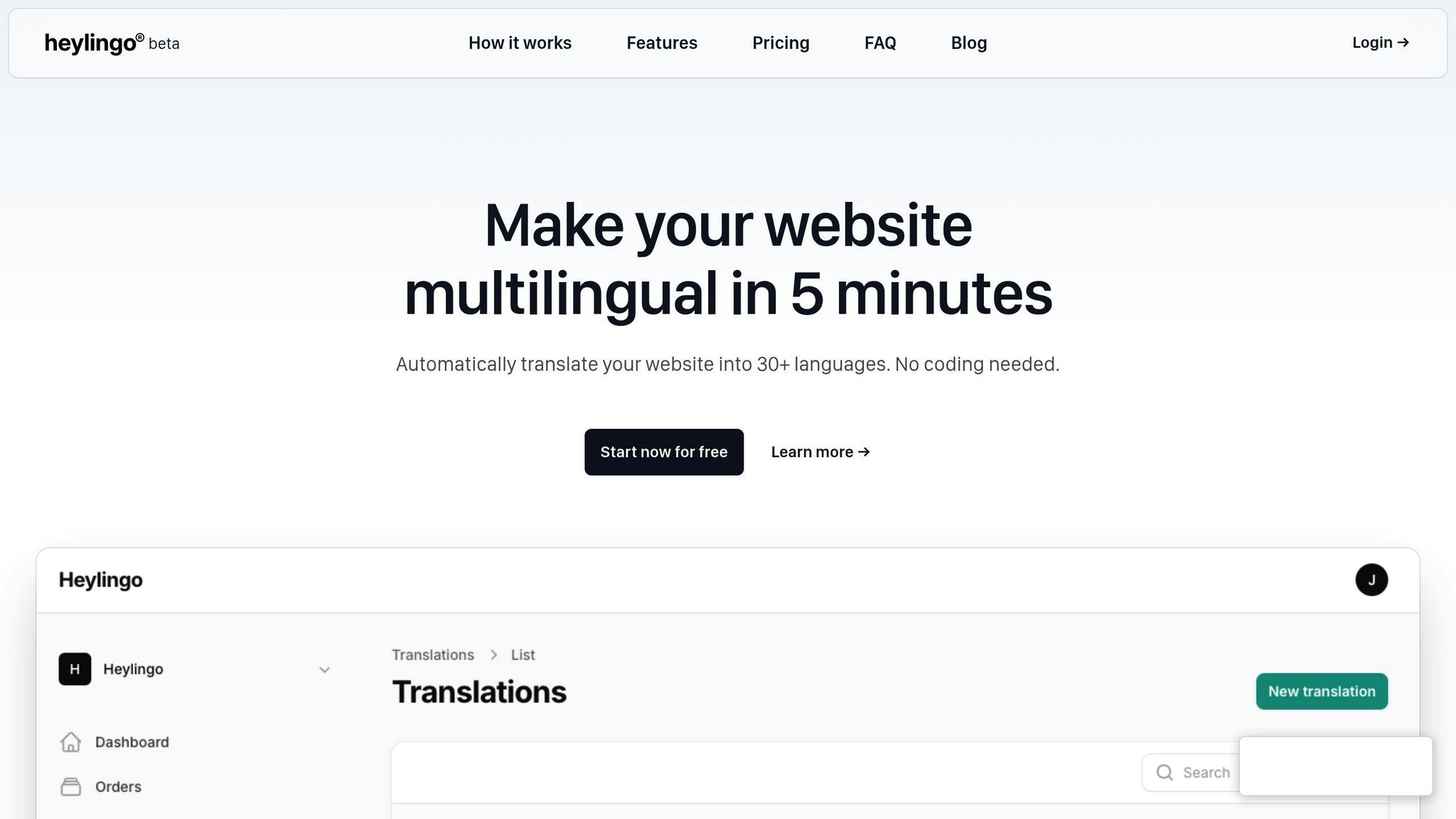
Heylingo is a SaaS platform built to make website translation easier for businesses aiming to reach a global audience. It addresses common hurdles like high costs, technical challenges, and inconsistent updates, offering a streamlined solution for multilingual content.
Key Features of Heylingo
Real-Time Translation
Heylingo delivers real-time translations in over 30 languages, ensuring your website is instantly accessible to international visitors. It supports dynamic websites and single-page applications while maintaining fast performance through its global CDN infrastructure, ensuring quick load times no matter where users are located.
Manual Editing for Accuracy
While AI powers the translation process, Heylingo allows manual editing to refine translations and ensure consistency with your brand’s tone. This combination of automation and human input ensures high-quality results, avoiding the errors that often come with fully automated systems.
Seamless Integration Across Platforms
Heylingo’s lightweight script integrates effortlessly with any CMS, custom platform, or e-commerce solution. For Shopify users, there’s a dedicated plugin that translates store content without disrupting existing functionality. This universal compatibility eliminates the technical headaches typically associated with localization.
Data Security and GDPR Compliance
Operating under strict European data protection rules, Heylingo complies fully with GDPR standards. This ensures businesses can expand globally without worrying about regulatory issues tied to customer data security.
Flexible Pricing Based on Usage
Heylingo uses a character-based pricing model, making it scalable for businesses of all sizes. Plans start at €10/month (around $11) for 100,000 translated characters, with options like the Scale plan at €69/month (about $75) for up to 1,000,000 characters. This approach ensures businesses only pay for what they use, keeping costs predictable and manageable.
These features directly tackle the challenges of localization, making global expansion more accessible.
How Heylingo Stands Out
| Feature | Traditional Translation Methods | Heylingo Solution |
|---|---|---|
| Setup Time | Weeks or months for full implementation | Minutes with lightweight script integration |
| Cost Structure | High upfront and ongoing fees | Predictable monthly pricing starting at €10 |
| Content Updates | Manual coordination, often delayed | Automatic real-time updates in all languages |
| Technical Requirements | Complex integration, developer needed | No coding required, works with any platform |
| Quality Control | Dependent on translator availability | AI-powered with manual editing options |
| Scalability | Costs rise with each language/page | Character-based pricing, unlimited team use |
Easy Integration for Any Business
Heylingo’s simplicity extends to its integration process, making it a fit for businesses of all sizes. Shopify store owners, for instance, can use the Heylingo app directly from the Shopify App Store to translate product descriptions, checkout pages, and customer communications - no need for additional tools or third-party systems.
For small businesses, the Starter plan covers 100,000 characters (roughly 20,000 words), enough for most small websites. As businesses grow, they can upgrade to Pro or Business plans, while larger enterprises can take advantage of the Scale plan, which supports up to 1,000,000 characters for a multilingual online presence.
Best Practices for Multilingual Website Success in 2025
Creating a multilingual website that resonates globally involves more than just translation. Businesses must focus on strategic market selection, legal compliance, and maintaining quality standards to build trust with diverse audiences. By balancing data-driven insights with cultural understanding, companies can ensure their localization efforts yield meaningful results.
Prioritize Target Markets and Languages
Leverage analytics to identify key languages. Tools like Google Analytics can show where your traffic originates, while keyword research highlights demand in specific languages. For instance, Spanish and Mandarin often cater to rapidly growing user bases.
Start small to maintain quality. Instead of tackling multiple languages at once, focus on a few. This approach helps refine your localization process while controlling costs. Gradual expansion also allows time to understand cultural nuances and improve effectiveness.
Account for regional language differences. Languages like Spanish and Portuguese vary significantly by region. Adapting terminology, currency formats, and even measurement units to suit local preferences can make your content more relevant and impactful.
Evaluate market size alongside purchasing power. A large number of speakers doesn’t always equate to high spending potential. In some regions, smaller audiences may have greater purchasing power and higher e-commerce adoption, making them worth targeting.
Once you’ve identified your target languages, the next step is adapting your content to align with local legal and cultural standards.
Ensure Accuracy and Regulatory Compliance
Adapt content to meet local legal requirements and formatting expectations. Display financial information in the correct currency and follow regional date formats. For example, U.S. audiences expect prices in dollars (e.g., $1,299.99) and dates in month/day/year format, while other regions may use local currencies and day/month/year formatting. Privacy policies should comply with relevant regulations, such as Europe’s GDPR or California’s CCPA.
Pay close attention to industry-specific terminology. Fields like healthcare or finance require precise language to meet regulatory standards. For example, the FDA’s guidelines differ from Europe’s CE marking requirements, making specialized translation essential.
Adapt visuals and messaging to cultural norms. Images, colors, and tone should reflect local preferences to avoid miscommunication or unintentional offense.
Validate translations with native speakers. While machine translation can be a good starting point, it often misses subtle differences. For example, terms like "investment bank" and "retail bank" carry distinct meanings. Human review ensures clarity, accuracy, and compliance.
After localization, maintaining translation quality and keeping content updated is crucial for user satisfaction and trust.
Maintain Translation Quality and Updates
Keep translations current as your business evolves. When product details, policies, or promotions change, make sure all language versions are updated simultaneously to avoid confusion or outdated information.
Track performance metrics and create language-specific style guides. Metrics like bounce rates, time on page, and conversion rates can reveal areas needing improvement. Style guides help maintain consistent messaging across languages, ensuring your brand voice resonates appropriately in each market.
Update time-sensitive content for local relevance. Seasonal promotions and campaigns should align with local holidays, academic calendars, and cultural events to maximize their impact.
Use customer feedback to improve translations. Feedback from international customers, often flagged by support teams, can highlight confusing or inaccurate translations. Addressing these issues quickly helps maintain trust.
Plan for batch updates as your global reach grows. Coordinating updates across languages ensures consistency and keeps all versions aligned with your business objectives.
Conclusion: Use Multilingual Websites to Stay Competitive
The digital world of 2025 pushes businesses to go beyond English-only websites if they want to remain relevant and thrive.
The advantages are undeniable: multilingual websites help you reach broader markets by connecting with users in their preferred language, foster trust by showing respect for local cultures, and improve SEO rankings in different regions.
In the past, challenges like navigating cultural subtleties and tackling technical hurdles made localization feel daunting. But now, modern translation tools have changed the game. They’ve simplified the process, making it more accessible and cost-effective, without requiring deep technical expertise or hefty investments.
Take Heylingo, for example. This platform uses AI to deliver smooth, budget-friendly translations in over 30 languages - no coding skills needed. It works with all CMS platforms, breaking down the barriers that once made localization such a challenge.
To put your multilingual strategy into action, start by using analytics to identify the most promising markets. Focus on a few key languages that align with your goals, and ensure every version of your site stays updated. Localization isn’t just about translation - it means adjusting currencies, date formats, and even legal compliance to meet local expectations.
The question isn’t whether you should launch a multilingual website in 2025 - it’s how soon you can make it happen. Take action now to tap into global markets and stay ahead of the competition.
FAQs
How can businesses maintain accurate and high-quality translations with AI-powered tools for multilingual websites?
To ensure accurate and polished translations, businesses should begin with clear, straightforward source content. AI-based tools perform much more effectively when the original text avoids ambiguity, excessive jargon, or unnecessarily complicated phrasing.
Using localization features in AI tools is another smart move. These features allow translations to be adjusted for specific cultural and regional subtleties, making the content feel more natural to the audience. Pairing this with regular reviews and adjustments by native speakers or professional linguists ensures the final product truly connects with its intended audience. By blending the speed of AI with the nuanced touch of human expertise, businesses can achieve top-notch results for multilingual websites.
How can I decide which languages to add when making my website multilingual?
Choosing the right languages for your website begins with understanding who your audience is and where your growth opportunities lie. Start by diving into market research to pinpoint regions where demand for your products or services is strong. Look at factors like demographics, income levels, and how relevant your offerings are to the local culture.
Next, take a close look at your website traffic and customer data. Where are your visitors coming from? Which locations generate the most inquiries or interest? This data can help you decide which languages to prioritize, ensuring you improve user experience and boost conversions where it matters most.
Lastly, think about the return on investment (ROI). Weigh the cost of localization against the potential revenue gains. A smart strategy is to begin with one or two key languages in regions with the highest potential, then expand gradually as you evaluate performance and gather user feedback.
How can a multilingual website boost your SEO and help you reach global markets?
A multilingual website can give your SEO efforts a boost by helping you tap into a wider variety of keywords across different languages. This means your site becomes more visible in localized search results, making it easier for users in specific regions to find you. By offering content that's tailored to the cultural and linguistic preferences of your audience, you align more closely with what users are looking for, which can lead to better rankings and more traffic from international markets.
On top of that, search engines tend to favor websites that cater to local languages and deliver a smooth user experience. This not only enhances your credibility but also strengthens your connection with diverse audiences. The result? A broader global reach and the ability to stay competitive in today’s interconnected marketplace.