Cultural Sensitivity In AI-Powered Translations
Translation tools often fail to account for the nuances of different languages and societies, creating risks for businesses aiming to connect with global audiences. Research shows that AI tools misinterpret context-specific language about 40% of the time. For example, literal translations often fail to convey idioms, emotional tones, or societal norms, which can lead to miscommunication or even harm a brand's reputation.
Here’s a quick breakdown of three popular AI translation tools:
- Google Translate: Best for speed and broad language coverage but struggles with deeper meaning, idioms, and formalities due to its reliance on statistical patterns.
- DeepL: Produces fluent, grammatically accurate translations but falls short in understanding complex societal and emotional subtleties.
- Heylingo: Combines AI with manual review by experts, allowing for more accurate translations that respect local norms and messaging.
For high-stakes content like marketing campaigns, blending machine efficiency with human expertise is essential to ensure accurate, context-aware translations.
Why Localization Still Needs Humans Even with AI
1. Google Translate
Google Translate is one of the best website translation tools, covering more than 130 languages. While it’s incredibly accessible and efficient, businesses should be aware of its limitations, especially when it comes to handling cultural nuances. These shortcomings highlight the importance of understanding how each translation tool approaches cultural differences. This is a core component of website localization, which ensures content resonates with local audiences.
Cultural Adaptation
Google Translate operates using statistical patterns rather than genuine cultural understanding. Its training data skews heavily toward Western languages - English alone accounts for 48% of the data used in major language models, and when combined with other European languages, that figure jumps to 86%. This imbalance creates a clear issue: translations often reflect a Western or U.S.-centric perspective, leading to what researchers call "imposed cultural bias".
The effects are clear in practice. For example, Google Translate misinterprets culturally specific phrases about 40% of the time. A notable case is the Japanese phrase "Mono no aware", which it translates as "the pathos of things." While technically correct, this misses the deeper, bittersweet appreciation of impermanence that defines the concept.
Context Retention
Literal translations are another common pitfall. Google Translate often substitutes words directly without accounting for idiomatic or metaphorical meanings. For example, the English idiom "spilling the beans" becomes meaningless when translated word-for-word into Japanese. The tool lacks the contextual awareness needed to determine when a phrase requires cultural interpretation instead of a direct translation.
This problem is particularly pronounced in high-context languages like Japanese and Korean, where meaning relies heavily on subtle social cues, hierarchy, and formality. Google Translate frequently misjudges these nuances, producing translations that are either too casual or excessively formal. As TLDRly explains:
"AI processes patterns; humans understand intent. When a phrase could go multiple ways, humans can draw on context AI can't access."
Customizability
Google Cloud Translation API does offer features like NMT customization, Adaptive Translation, and Glossaries to improve accuracy for specific domains. However, these tools don’t fully address the underlying cultural limitations. Even with customization, the system remains grounded in its statistical framework, which lacks the flexibility to adapt to cultural intricacies.
Scalability
Where Google Translate shines is in handling large volumes of text quickly. It’s ideal for situations where speed takes priority over cultural precision, such as reviewing user feedback, translating internal documents, or processing basic content. However, as AI-generated translations become more polished, their fluency can sometimes obscure deeper cultural inaccuracies.
The tool also struggles to keep up with evolving language trends, such as new slang or shifting cultural references. Since its models are trained on historical data, they can feel outdated until retrained. This means Google Translate may miss contemporary nuances that have developed since its last update. Up next, we’ll explore how other tools tackle these cultural challenges.
2. DeepL
DeepL uses advanced neural networks to produce translations that sound natural and are grammatically accurate. While it excels at literal translations and proper grammar, it often misses the mark when it comes to capturing cultural context, emotional undertones, and intended meanings. For instance, it can accurately translate the English idiom "let the cat out of the bag" into German (die Katze aus dem Sack lassen), but the same literal approach fails to convey the intended meaning in French. Humor, sarcasm, and culturally rooted metaphors often pose challenges for DeepL, as do varying norms of formality and politeness. These shortcomings can be problematic in sensitive areas like diplomacy or politics. Additionally, its training data reflects human biases, such as associating male pronouns with doctors and female pronouns with nurses, or linking terms like "anxious" more often with women. Booker Prize-winning translator Michele Hutchison highlights this gap:
"A translator translates more than just words; we build bridges between cultures, taking into account the target readership every step of the way".
Context Retention
DeepL enhances translation quality by focusing on the lexical, syntactic, and semantic elements of language. Its interface allows users to choose synonyms and alternative sentence structures, making it a valuable drafting tool for Machine Translation Post-Editing (MTPE). In these workflows, human linguists refine the AI's output to ensure it resonates culturally. However, despite its strengths, DeepL's reliance on statistical patterns limits its ability to fully grasp deep cultural nuances.
Customizability
While DeepL incorporates a feedback loop to improve its performance over time, it offers limited options for tailoring translations to align with regional cultural preferences. Adjusting tone and formality to suit local norms often requires manual intervention by users. This highlights the ongoing need for tools that combine technical translation capabilities with cultural sensitivity.
Scalability
DeepL is well-suited for handling large-scale content like user support articles, product descriptions, and internal documents. However, its output is more consistent and accurate for widely spoken, data-rich languages like English and Spanish, while translations for less-represented languages may fall short. For creative or high-impact content - such as advertising slogans or brand messaging - businesses are encouraged to move beyond basic translation and invest in transcreation. This approach, led by human experts, adapts the message to evoke the same emotional response in the target audience.
Next, we’ll explore how Heylingo balances speed with cultural precision.
sbb-itb-8482ffa
3. Heylingo
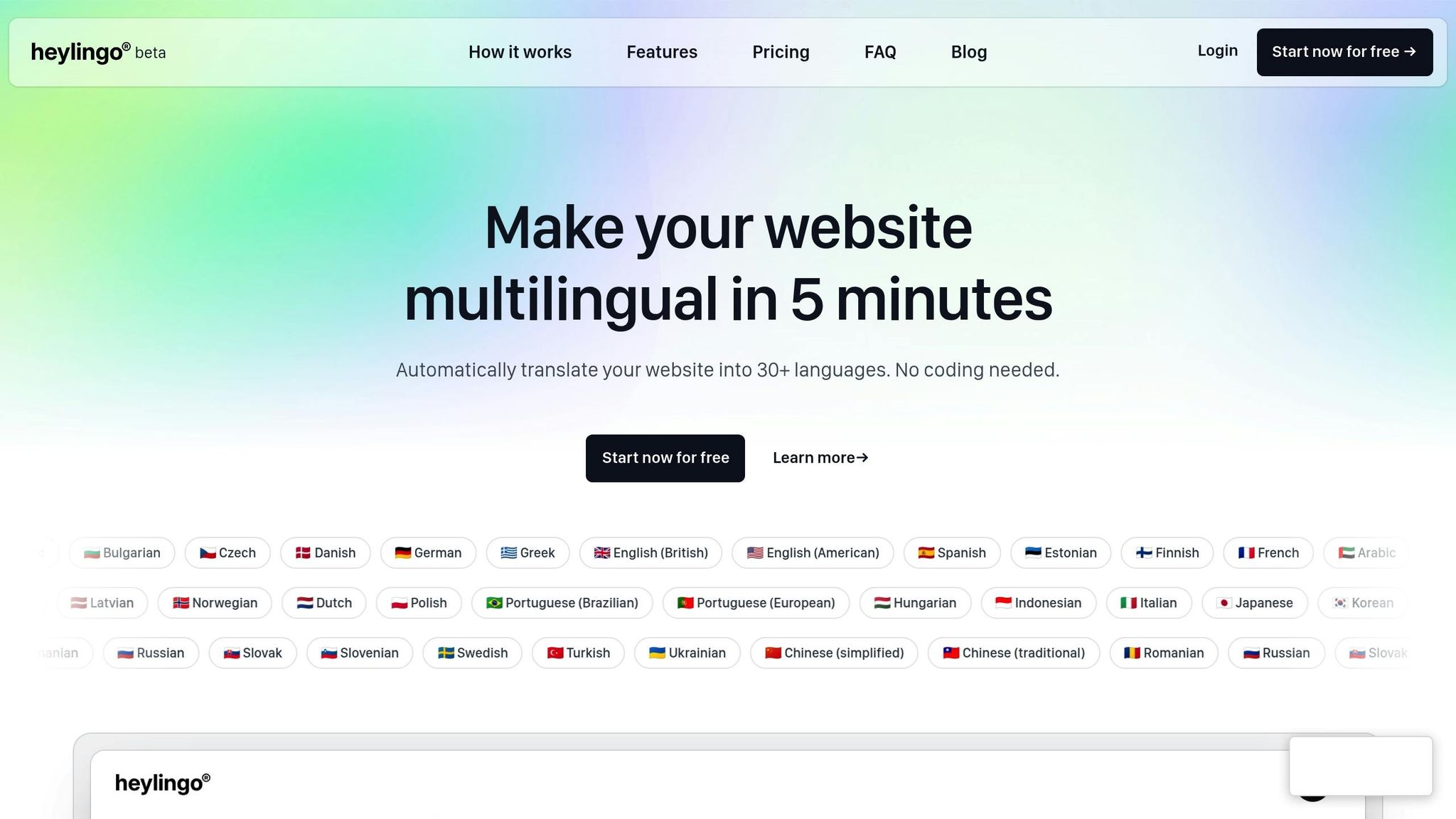
Heylingo blends the speed of AI with the expertise of human oversight to deliver translations that respect cultural nuances. This platform can translate websites into over 30 languages in just minutes, offering an intuitive dashboard for reviewing and refining the output. Professional linguists step in as cultural experts, ensuring that even the most subtle aspects of language are translated accurately.
Cultural Adaptation
Heylingo stands out by combining automation with human input, making it ideal for businesses looking to adapt their marketing messages to new audiences. Its approach goes beyond basic translation by incorporating transcreation - a method that adapts content to evoke the same emotional impact in the target language. While the AI handles straightforward tasks with ease, the platform's manual editing tools allow for fine-tuning slogans, brand messaging, and other content where tone and cultural context are critical.
Customizability
One of Heylingo's standout features is its ability to be tailored to individual business needs. The platform includes an integrated glossary and style guide, enabling companies to input their preferred brand terminology and industry-specific language. This ensures that translations stay aligned with brand standards. Additionally, the system learns from manual edits, gradually improving its output to better match the desired tone and style.
Scalability
Heylingo offers flexible pricing that caters to a range of needs, from small businesses to large enterprises. The Starter plan, priced at about $11 per month, supports up to 100,000 translated characters (roughly 20,000 words). For larger projects, the Scale plan costs approximately $76 per month and accommodates up to 1,000,000 characters (around 200,000 words). The platform is compatible with any CMS, custom platform, or online store and features a dedicated Shopify plugin for e-commerce users. To enhance the user experience, Heylingo employs fast global CDN servers, ensuring translated pages load quickly no matter where users are located. These scalable options highlight Heylingo's versatility and adaptability for a variety of use cases.
Strengths and Weaknesses
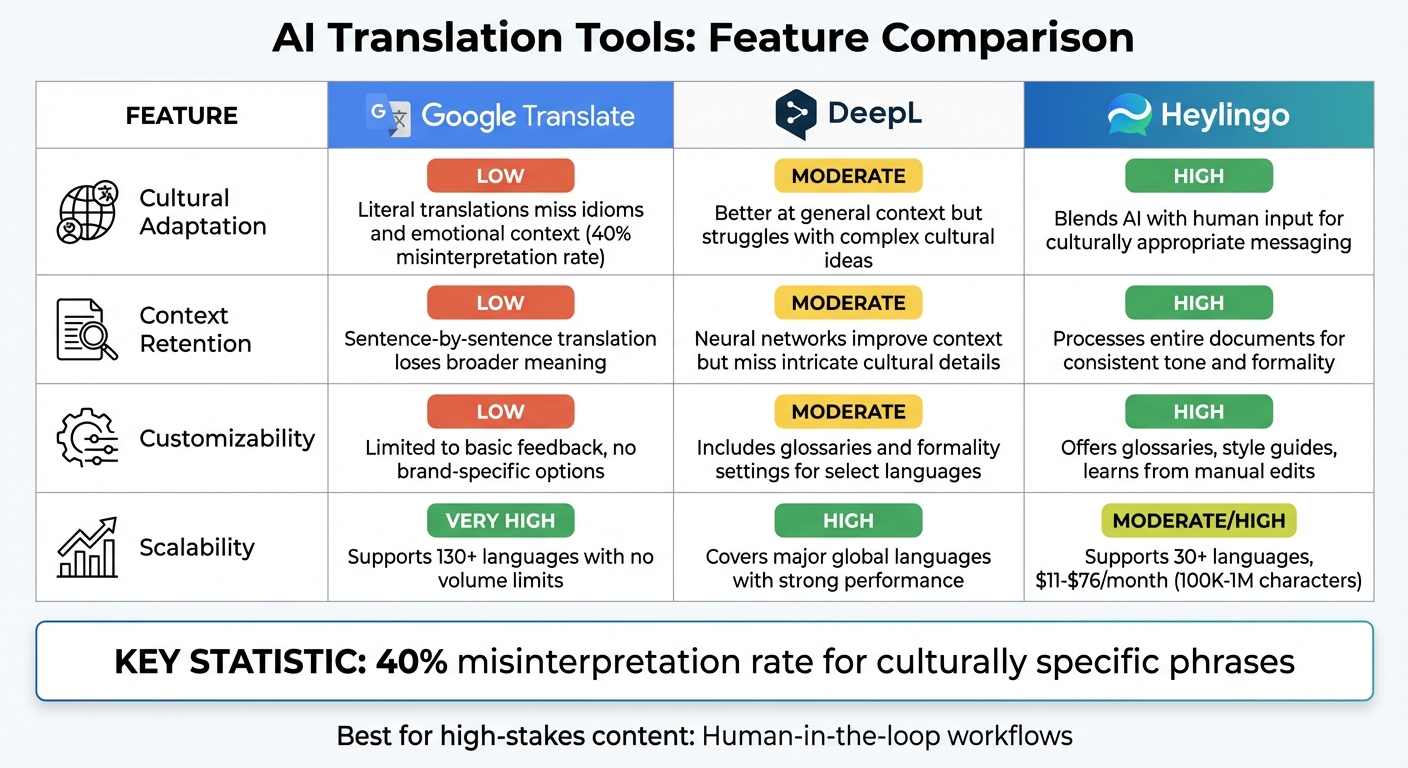
AI Translation Tools Comparison: Google Translate vs DeepL vs Heylingo
After examining each translation tool in detail, let's take a closer look at their overall strengths and weaknesses. Each platform approaches cultural nuances differently, balancing speed, accuracy, and human involvement in unique ways. The table below provides a side-by-side comparison of these key factors.
| Feature | Google Translate | DeepL | Heylingo |
|---|---|---|---|
| Cultural Adaptation | Low; often delivers literal translations that miss idioms and emotional context | Moderate; better at understanding general context but struggles with complex cultural ideas | High; blends AI with human input for culturally appropriate and nuanced messaging |
| Context Retention | Low; translates sentence-by-sentence, losing broader meaning | Moderate; neural networks improve context but fall short with intricate cultural details | High; processes entire documents to ensure consistency in tone and formality |
| Customizability | Low; limited to basic feedback without brand-specific options | Moderate; includes glossaries and formality settings for select languages | High; offers glossaries, style guides, and learns from manual edits for tailored output |
| Scalability | Very High; supports hundreds of languages with no volume limits | High; covers major global languages with strong performance | Moderate/High; supports 30+ languages with pricing from $11/month (100,000 characters) to $76/month (1,000,000 characters) |
These differences become clear in real-world scenarios. For example, Google Translate once mistranslated the Spanish slang "no manches" as "no stain", completely missing its conversational meaning. Similarly, it turned the playful pun "Will you brie mine?" into the literal and awkward Italian phrase "Do you want to be my cheese?".
The data highlights a recurring theme: general-purpose AI tools prioritize volume and speed over precision and cultural understanding. On the other hand, platforms like Heylingo combine machine efficiency with human expertise, making them better suited for high-stakes content like marketing campaigns, brand messaging, or customer-facing materials. After all, speed alone won’t ensure your message connects with local audiences - or avoid embarrassing translation blunders.
Conclusion
AI translation tools still fall short when it comes to handling the cultural nuances required for high-stakes content. Studies reveal that AI misinterprets culturally specific phrases about 40% of the time, which can pose serious risks for brands that rely solely on automation. The best solution? A combination of machine efficiency and human expertise, often called a "human-in-the-loop" workflow.
A well-rounded strategy involves organizing content into tiers. For example, marketing slogans, homepage text, and customer-facing campaigns should go through transcreation - a process where linguists adapt both the language and emotional tone to fit the target audience. On the other hand, high-volume content like support articles or technical product specifications can be handled by AI, with a layer of human post-editing to ensure quality. This approach strikes a balance between cost, speed, and cultural adaptation.
As discussed earlier, Heylingo exemplifies this balanced approach. With customizable workflows, support for over 30 languages, integrated glossaries, and real-time editing tools, Heylingo helps you scale multilingual content while preserving the cultural subtleties that matter. Plans start at $11 per month for 100,000 characters, making it a practical choice for businesses looking to expand internationally.
FAQs
Why do AI translation tools struggle with capturing cultural nuances?
AI translation tools often stumble when it comes to capturing the subtleties of cultural nuances. These tools work by identifying statistical patterns in language rather than truly understanding the deeper cultural context. While they can effectively match words between languages, they often miss the mark with emotional tone, idiomatic expressions, or context-specific meanings that give phrases their cultural weight. Take, for instance, the Japanese concept of mono no aware or the German term Weltschmerz - both convey profound emotional and philosophical ideas that AI struggles to convey accurately.
Another challenge lies in the training data for many AI models, which tends to prioritize widely spoken languages like English. This focus can introduce biases and lead to errors when translating less common languages or regional dialects. The result? Translations that feel overly literal, lack depth, or even distort the original message. For businesses - particularly in marketing or customer engagement - this underscores the need to pair AI tools with human translators. This combination ensures translations are not only accurate but also resonate authentically within the cultural context.
How can businesses ensure culturally accurate translations for critical content?
To ensure that critical content - like legal documents, medical instructions, or marketing campaigns - is translated accurately and resonates with local audiences, businesses should leverage a combination of AI tools and human expertise. While AI-powered translations offer speed and scalability, they can fall short when it comes to capturing subtleties like tone, idiomatic expressions, or cultural nuances.
A practical strategy involves using AI for the initial translation, followed by transcreation performed by professional linguists. This step ensures the message maintains its original meaning, tone, and intent. To further refine the content, native-speaking proofreaders or cultural consultants can review it, catching errors and aligning it with local expectations. Incorporating style guides and glossaries into the process also helps maintain consistency and clarity across translations.
Heylingo streamlines this entire workflow by offering translations in over 30 languages and providing an easy-to-use dashboard for reviewing and refining content. By integrating human oversight into the final stages, businesses can ensure their messages are accurate, culturally appropriate, and ready for even the most demanding contexts.
Why is human expertise important in AI-powered translations?
While AI translation tools are undeniably quick and efficient, they often fall short when it comes to understanding the subtleties of language - things like idioms, humor, and etiquette. These are areas where cultural understanding is key, and this is precisely why human expertise remains so important. Native-speaking linguists can step in to refine AI-generated translations, making sure the final result feels natural and aligns with cultural expectations.
Human reviewers also bring something else to the table: the ability to spot and correct biases, maintain a consistent brand voice, and ensure the tone meets legal and professional standards. By blending the speed of AI with the insight of human experts, businesses can create translations that connect with audiences across different regions while protecting their brand image.
Heylingo takes this hybrid approach to the next level. It allows businesses to instantly translate their websites into more than 30 languages and provides tools to review and polish every detail. The result? A smooth, localized experience tailored to each market.