Translation Tools vs. Privacy Laws
Translation tools can simplify global communication, but they come with privacy risks. If your business uses these tools, you need to ensure compliance with privacy regulations like GDPR and CCPA.
The problem? Many translation tools process, store, or reuse sensitive data in ways that may violate these laws. This can result in hefty fines - up to €20 million under GDPR or $7,500 per violation under CCPA - along with damage to your reputation.
Here’s what you need to know:
- GDPR requires explicit consent, data minimization, and strict data retention policies. Data transfers outside the EU must meet specific safeguards.
- CCPA focuses on user rights, like opting out of data sharing, deleting personal information, and correcting errors.
- Free translation tools often use your data to train AI models, creating compliance risks. Paid tools with strong encryption and no AI training are safer.
Key takeaway: Choose tools that prioritize privacy, offer clear data processing agreements, and comply with regulations. Tools like Heylingo stand out for their secure, GDPR-compliant approach, ensuring your business stays protected while operating internationally.
Translate Text and Documents Instantly with Lara Translate | Fast & Accurate AI Translation Tool
sbb-itb-8482ffa
GDPR and CCPA: What You Need to Know
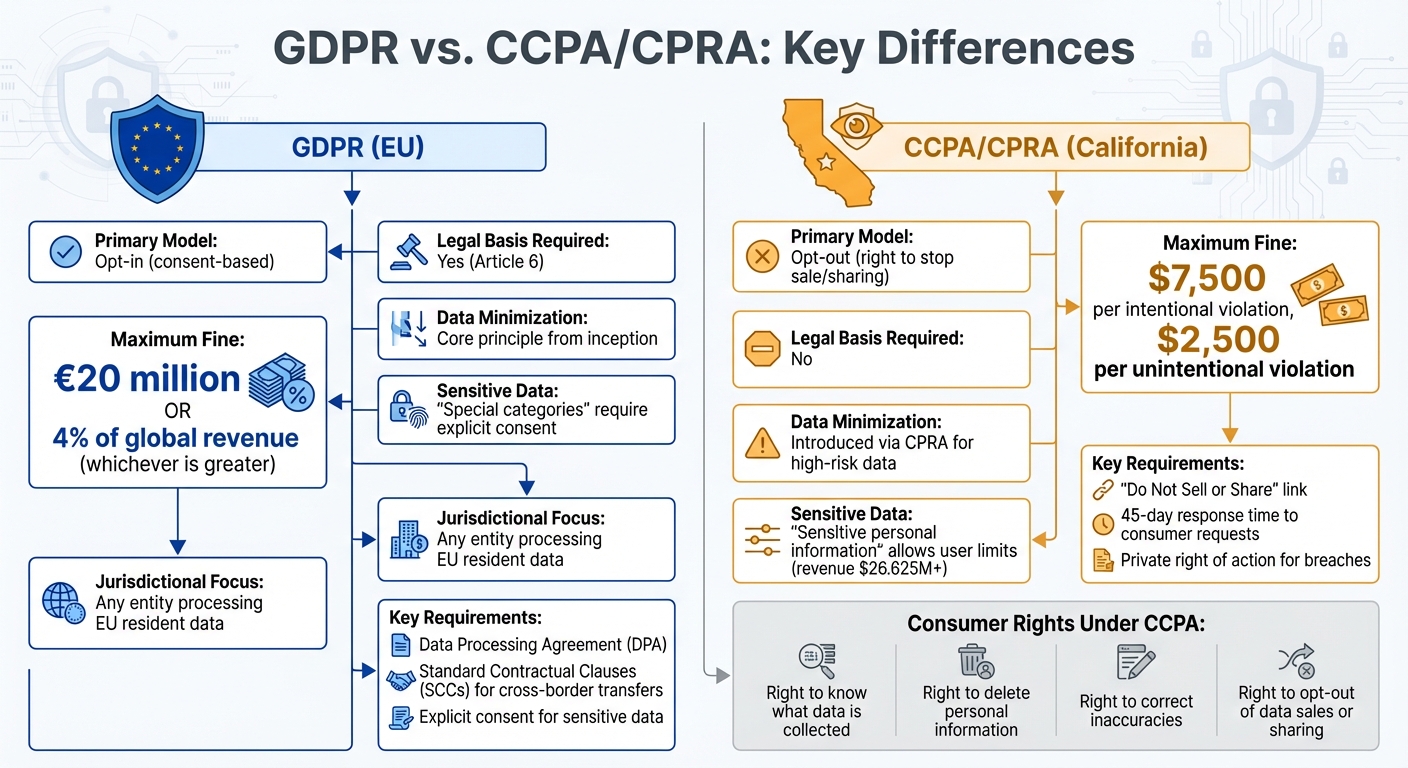
GDPR vs CCPA Privacy Requirements Comparison for Translation Tools
The General Data Protection Regulation (GDPR) and the California Consumer Privacy Act (CCPA) establish strict guidelines for handling personal data. GDPR, aimed at companies processing data from EU residents, mandates explicit consent before processing personal information. On the other hand, CCPA, which applies to for-profit businesses in California with annual revenues of $26.625 million or more (effective January 1, 2025), operates on an opt-out model, allowing consumers to stop the sale or sharing of their data.
"A fundamental principle of the GDPR is the requirement to have a 'legal basis' for all processing of personal data. That is not the case for the CCPA." - Francesca Ternullo, Author
GDPR compliance for translated websites is essential, as violations can lead to fines as high as €20 million or 4% of global annual revenue, while CCPA violations carry penalties of up to $7,500 per intentional violation and $2,500 for unintentional violations, with statutory damages ranging from $100 to $750 per incident. Below, we’ll break down the requirements of these regulations and their relevance to translation tools.
GDPR Requirements
GDPR emphasizes data minimization, requiring businesses to collect only the personal data necessary for a specific purpose, as outlined in Article 5. For translation tools, this means processing only the data essential to the translation task. Additionally, the regulation enforces purpose limitation, ensuring that data collected for one purpose - like translation - cannot be repurposed without additional consent.
When third-party translation services are involved, GDPR mandates a Data Processing Agreement (DPA) that specifies how data will be handled, including its purpose, duration, and nature. For cross-border data transfers outside the EU, businesses must implement safeguards like Standard Contractual Clauses (SCCs) to uphold data protection standards.
Privacy notices play a critical role under GDPR. They must clearly explain what data is collected, the legal basis for processing, retention periods, and any international transfers. For sensitive data - such as information about health, ethnicity, or religion - explicit consent is required before processing.
CCPA and CPRA Standards
CCPA and its amendment, the California Privacy Rights Act (CPRA), introduce robust rules for data handling, though their focus differs from GDPR in key areas. CCPA broadly defines personal information to include any data that identifies or relates to a consumer or household, including sensitive details like email or text message content. CPRA builds on this by granting consumers the right to restrict the use and disclosure of sensitive data.
Under CCPA, businesses must collect and retain only the data necessary for their stated purpose, a principle that aligns with GDPR’s data minimization focus. However, CPRA specifically applies this to high-risk data processing. Websites are also required to display a visible "Do Not Sell or Share My Personal Information" link, along with an option to "Limit the Use of My Sensitive Personal Information" when applicable.
CCPA grants consumers several key rights, including:
- Right to know what data is collected
- Right to delete personal information
- Right to correct inaccuracies
- Right to opt-out of data sales or sharing
Businesses must respond to these requests within 45 calendar days. Unlike GDPR, CCPA includes a private right of action for data breaches, allowing consumers to sue directly in cases of security lapses.
| Feature | GDPR (EU) | CCPA/CPRA (California) |
|---|---|---|
| Primary Model | Opt-in (consent-based) | Opt-out (right to stop sale/sharing) |
| Legal Basis Required | Yes (Article 6) | No |
| Data Minimization | Core principle from inception | Introduced via CPRA for high-risk data |
| Sensitive Data | "Special categories" require explicit consent | "Sensitive personal information" allows user limits |
| Maximum Fine | €20 million or 4% of global revenue | $7,500 per intentional violation |
| Jurisdictional Focus | Any entity processing EU resident data | For-profit entities doing business in CA |
Both GDPR and CCPA require businesses to map their data flows, establish processes for responding to consumer rights requests, and ensure vendor contracts clearly define data handling responsibilities. For translation tools, this means carefully managing data storage, retention periods, and ensuring data is used exclusively for translation purposes.
Data Privacy in Translation Tools
Translation tools offer convenience but come with privacy concerns. When you submit text for translation, you're often sharing sensitive information - like customer details, financial data, or proprietary content. How this data is handled, stored, and deleted plays a crucial role in determining whether the tool aligns with GDPR or CCPA standards. Understanding these processes is key to navigating the compliance landscape.
In this relationship, you are the data controller (deciding what gets translated), while the translation tool acts as the data processor (handling the actual translation). This setup requires a formal Data Processing Agreement (DPA) to outline how your data will be managed. Under CCPA, the focus shifts to user control, ensuring individuals can opt out of data sales and request permanent deletion of their information.
To ensure privacy, robust encryption is essential. Leading tools rely on TLS 1.3 for securing data in transit and AES-256 encryption for protecting stored data. They also minimize data collection, avoiding unnecessary details like IP addresses or browsing history.
"A properly designed translation service shouldn't require human access to your content. Ever." - Nicolai Schmid, noll.to
A major privacy issue arises with AI training. Many free translation services use uploaded text to improve machine learning models. Under GDPR, this practice requires explicit consent and creates challenges for data deletion, as once data is integrated into a neural network, removing it is nearly impossible. Privacy-driven tools avoid this entirely, ensuring user data isn't used for training purposes.
Data residency is another key consideration. GDPR-compliant tools often guarantee "EU-only" processing, meaning data remains within European jurisdictions throughout its lifecycle. This includes uploads, storage, backups, and even CDN routing. Additionally, high-compliance tools enforce short retention periods, with some deleting both original and translated files permanently within 30 minutes.
GDPR Compliance Features
GDPR compliance emphasizes strict data retention policies, avoiding AI training, and transparent handling practices. Tools that adhere to these standards often implement automatic deletion protocols, sometimes as short as 30 minutes after completing the translation.
Heylingo exemplifies this approach by delivering translations via a fast CDN without storing long-term copies. Acting as a translation layer rather than a data repository, it minimizes the processing of personal data. Basic functionality doesn't even require user accounts, reducing the collection of personally identifiable information (PII).
Data residency is another cornerstone of GDPR compliance. Tools like Heylingo ensure all data processing, including backups and CDN operations, happens within the EU or jurisdictions with adequate data protection standards. This infrastructure safeguards your content throughout the translation process.
Heylingo also provides transparency through its dashboard, allowing you to review and edit translations before they go live. This puts control over processed data directly in your hands.
CCPA Compliance Features
CCPA compliance focuses on user control and transparency, emphasizing the right to opt out of data sales, delete personal information, and correct inaccuracies. Translation tools must offer clear options for managing these rights.
For tools like Heylingo, compliance means empowering users with visibility and control. Its dashboard lets you review, edit, and delete translations as needed. Since Heylingo avoids using customer content for AI training or analytics, deletion requests are straightforward and comprehensive.
The "Do Not Sell or Share My Personal Information" clause is especially relevant for tools that might share data with third parties. Heylingo avoids this by strictly processing content for translation purposes only, ensuring it isn't sold, shared, or used for unrelated activities.
CCPA also grants users the right to correct errors. Heylingo simplifies this by allowing direct edits to translations. If a translated page contains incorrect or outdated personal information, you can fix it immediately without filing formal correction requests. These measures make Heylingo a strong example of privacy-conscious translation practices.
Privacy Risks in Translation Tools
Using translation tools can open the door to privacy risks that may lead to regulatory penalties for businesses. A key concern is how AI model training operates. Many free translation services use the text you submit to improve their neural networks. Once personal data is absorbed into a model, removing it becomes nearly impossible . This highlights how data can be repurposed in ways users might not anticipate.
"If the tool has already used your data to train a model, 'deletion' becomes... complicated. You can delete the document, but the model has already learned from it." – Nicolai Schmid, noll.to
Another issue is data retention practices, which can further complicate compliance. Some providers keep user text indefinitely, often for analytics or maintaining user history. This approach can conflict with the GDPR's "storage limitation" principle, leaving businesses exposed to long-term risks. Even when services claim to use "EU data centers", data might still pass through global CDNs or be backed up on servers in the U.S. .
Encryption weaknesses add another layer of vulnerability. Without robust encryption protocols like TLS 1.3 or AES-256, some tools fail to meet basic industry standards. Poor encryption not only puts sensitive data at risk but also jeopardizes compliance. On top of that, some services allow their staff to access user content for debugging purposes, which increases the potential for breaches.
The consequences for regulatory non-compliance can be severe. Violating GDPR, CCPA, or HIPAA due to insecure translation tools can lead to hefty financial penalties, damage to professional reputations (especially for law firms), and a loss of trust in sensitive sectors like healthcare. Free tools are particularly risky, as they often monetize user data by feeding it into analytics and model training, all without offering clear legal safeguards.
How to Evaluate Translation Tools for Privacy
When it comes to translation tools, privacy isn't just a nice-to-have - it’s a must. To ensure compliance with data protection laws like GDPR, you need to carefully assess each tool’s privacy features. Start by confirming whether the vendor qualifies as a GDPR data processor. A trustworthy provider should offer a Data Processing Agreement (DPA) as part of their compliance documentation.
"'GDPR compliant' has become the 'organic' of SaaS. Everyone slaps it on the label. Nobody checks the ingredients".
Don’t settle for vague claims - ask for written proof.
Next, look at the tool's data retention policy. A clear, specific storage duration (e.g., 30 minutes) is a good sign. Also, find out if the service uses your data to train AI models. This is especially important with free tools, as their business model often relies on user data for AI training. Paid versions, on the other hand, usually include contractual guarantees that protect customer data from being used for such purposes.
Security measures are another critical factor. Check if the tool uses TLS 1.3 for data in transit and AES-256 encryption for data at rest. Beyond encryption, a "zero human access" policy - where no staff or engineers can view your content - indicates a strong commitment to privacy. Additionally, ask for a list of subprocessors to understand where and how your data is stored or processed.
By focusing on these technical and policy-based safeguards, you can make an informed choice. The following table offers a side-by-side comparison of privacy features among various translation tools.
Privacy Feature Comparison Table
Here’s how different translation tools stack up against key privacy criteria:
| Feature | Free Translation Tools | DeepL Pro | Privacy-First Tools (e.g., Noll) | Heylingo |
|---|---|---|---|---|
| GDPR/CCPA Compliance | Often non-compliant (no DPA) | Compliant (DPA available) | Compliant (DPA available) | Fully GDPR-compliant |
| AI Model Training | Yes (uses your data) | No | No | No training on customer data |
| Data Retention | Often indefinite/vague | Temporary (deleted after use) | 30 minutes (automatic deletion) | Minimal retention |
| Data Location Assurance | Global/Vague | EEA Infrastructure | EU-only (end-to-end) | EU-based processing |
| Encryption | Varies | Standard encryption | TLS 1.3 + AES-256 | Industry-standard encryption |
| Human Access | Possible for "improvement" | Restricted | Zero human access | No human access to content |
If you're considering translation tools for website localization, Heylingo stands out. It ensures GDPR compliance, offers fast CDN delivery, and provides an easy-to-use dashboard for reviewing translations. Importantly, it processes data securely without using customer content to train AI models. With GDPR fines surpassing €5.88 billion, choosing a compliant tool is no longer optional - it’s critical for protecting your business and its users.
Conclusion
Selecting the right translation tool isn't just a convenience - it's a legal obligation. Under GDPR Articles 12, 13, and 14, businesses must ensure that the information they provide is "clear, transparent, and easily understandable". Missteps in translation quality can lead to compliance issues and hefty fines. A prime example: in 2021, the Dutch Data Protection Authority fined TikTok €750,000 for failing to provide its privacy policy in Dutch, leaving Dutch-speaking children unable to understand how their data was being used. This case serves as a reminder that proper translation isn't optional - it's a requirement.
GDPR fines can climb as high as €20 million or 4% of a company's global revenue, whichever is greater. Adding to the risk, many free translation tools store submitted content indefinitely or use it to train AI models, practices that conflict with the GDPR's data minimization principle.
"If you're not paying, ask yourself: what's the business model?" - Nicolai Schmid, noll.to
For businesses managing sensitive data - like employee contracts, customer details, or legal documents - using tools without robust safeguards can result in regulatory penalties and damage to customer trust. This is why companies need a secure, privacy-first solution to support global growth.
Heylingo offers a GDPR-compliant translation platform tailored for SMBs and website owners expanding internationally. Based in Frankfurt am Main, Germany, Heylingo operates under EU law and provides a formal Data Processing Agreement (DPA) for B2B clients. Unlike generic AI-powered tools, Heylingo processes content exclusively for translation purposes. It delivers fast, CDN-backed translations in over 30 languages with no coding required.
For businesses translating their websites, Heylingo combines ease of use with accountability. It integrates smoothly with any CMS, custom platform, or Shopify store, and features a user-friendly dashboard for reviewing and fine-tuning translations. With EU-based processing and strict data protection measures, Heylingo ensures compliance while helping businesses connect with global audiences. By balancing efficiency with rigorous data protection, companies can confidently scale their operations. When privacy regulations demand precision and transparency, Heylingo provides a trustworthy and compliant solution.
FAQs
Does using a translation tool make me a data controller?
When you use a translation tool, it doesn’t necessarily mean you’re a data controller. However, if you’re the one deciding how and why personal data is processed during translation, you could be considered a data controller under GDPR. This depends on whether you define the purposes and methods for handling the data.
What should be included in a translation tool’s DPA?
A Data Processing Agreement (DPA) for a translation tool should clearly define several critical aspects. These include the purpose of data processing, the types of personal data being handled, the categories of individuals whose data is processed, and the responsibilities of the processor.
Key points to focus on are ensuring compliance with GDPR by incorporating measures like data minimization, clear retention policies, data residency requirements, and effective oversight of any subprocessors involved in handling the data.
How can I tell if my text is used for AI training?
To determine if your text is being used for AI training, start by reviewing the service provider’s privacy policy. Pay close attention to sections about data storage, usage, and sharing. Laws like GDPR and CCPA mandate transparency, meaning companies are required to disclose if your data is used for training purposes. If you want to safeguard your privacy, look for ways to opt out of data sharing or select services that clearly state they do not use your content for training.